
In November 2025, Alibaba Group launched the public beta of the Qwen App, a consumer-facing artificial intelligence application that surpassed 10 million downloads within its first week.
By January 2026, Alibaba had rolled out a major upgrade that changed the app from a conversational chatbot into what the company calls “AI that acts.” The shift matters because Qwen is no longer positioned only as a tool for answers, summaries, or content generation.
It is becoming Alibaba’s blueprint for a new consumer internet interface. This interface is command-based, transaction-capable, and deeply connected to the digital services Chinese consumers already use every day.
What Is Qwen AI and the New AI Interface
Qwen AI is Alibaba’s flagship family of large language models, developed by the company’s Tongyi Lab. The Qwen series has become one of the world’s most widely adopted open-source AI model families, with more than 140,000 derivative models created and global downloads exceeding 600 million.
In 2025, Alibaba released Qwen3, the latest generation of the model family. Qwen3 introduced hybrid reasoning models that combine traditional large-language-model capabilities with advanced dynamic reasoning.
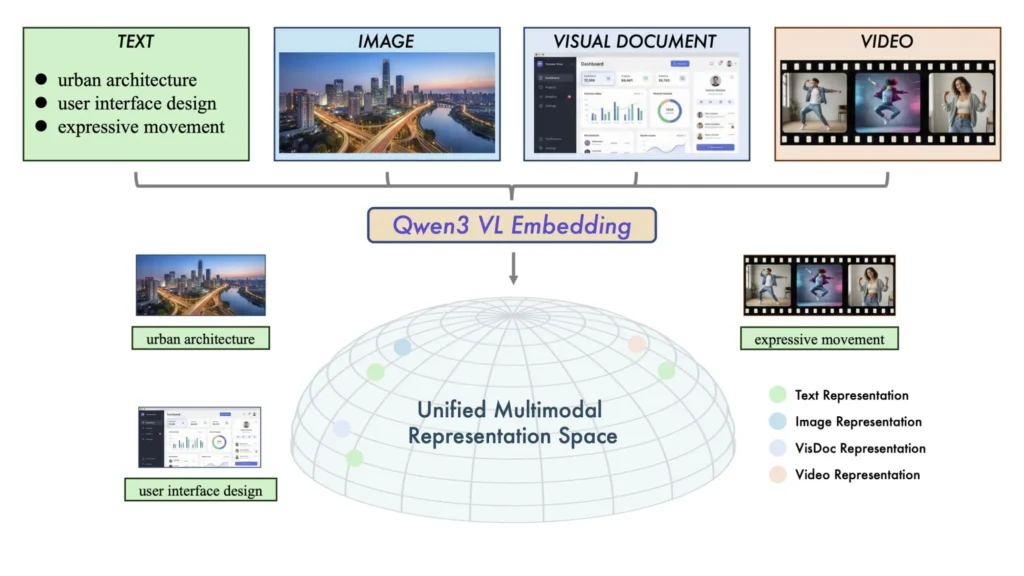
The Qwen3 family also expanded to include larger, more multimodal systems. It includes models with up to 1 trillion parameters, along with variants such as Qwen3-VL for vision tasks and Qwen3-Omni for real-time audio, image, and video processing.
This model layer powers more than the consumer-facing Qwen App. It also supports Alibaba Cloud’s enterprise AI offerings, the Quark AI browser, and Alibaba’s growing portfolio of AI-native hardware. That makes Qwen AI central to Alibaba’s broader AI strategy, not just a single consumer product.
The Qwen App: A New Consumer Interface

The Qwen App is available for free across iOS, Android, web, and PC platforms in China. Alibaba has also planned an international version for markets outside China. The app is built on Alibaba’s most advanced Qwen models and positions itself as “the best personal AI assistant.”
That label does not fully capture what Alibaba is building.
The Qwen App represents a deeper rethink of how consumers interact with digital services. Traditional consumer internet interfaces are app-centric. A user opens Taobao to shop, Alipay to pay, Amap to navigate, and Fliggy to book travel. Each task starts inside a separate app.
Qwen changes this logic. It becomes a single conversational AI interface where users express intent in natural language, then Alibaba’s ecosystem executes that intent behind the scenes.
An AI interface is the layer where people express what they want, and systems translate that intent into output. In older consumer internet design, the interface was a screen full of menus, search boxes, tabs, filters, and buttons. In the Qwen App, the interface becomes a conversational command layer connected to real services.
For leaders trying to understand what an AI interface is, China offers a practical answer. It is not only a chatbot. It is a control layer that can connect language, payment, commerce, mobility, location, logistics, service, and user history.
From Conversation to Transaction Execution
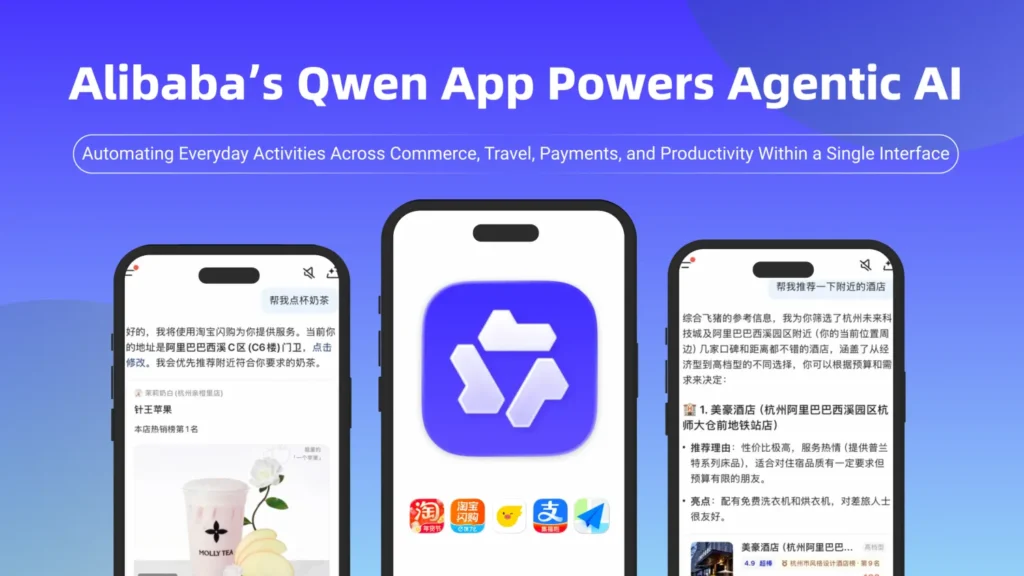
The January 2026 upgrade marked the decisive shift. Alibaba deeply integrated the Qwen App with core ecosystem services, including Taobao, Taobao Instant Commerce, Alipay, Fliggy, and Amap. The result is a system where a single voice or text request can complete actions that once required several apps.
Wu Jia, Vice President of Alibaba Group, described the shift clearly at the product launch: “AI is evolving from intelligence to agency. What we are launching today represents a shift from models that understand to systems that act, deeply connected to real-world services.”
A live demonstration showed what this means in practice. Wu asked the Qwen App to order 40 cups of bubble tea. The app placed the order through Taobao Instant Commerce, applied available discounts, completed payment via Alipay, and scheduled delivery inside the chat interface.
This is where one sentence ordering becomes more than a convenience feature. It changes how retail journeys begin. A user does not need to open a food delivery tab, search for a store, compare discounts, select items, and enter payment details. The user can simply ask for a result.
That is command-based commerce. It compresses discovery, decision-making, checkout, payment, and delivery into one conversational flow.
Alipay is especially important in this model. An assistant who recommends a product still depends on user patience. An assistant that can complete payment inside the same flow becomes a much stronger transaction interface.
Fliggy and Amap add another layer. Travel and mobility decisions often require comparison, routing, timing, location context, and confidence in booking. Once these services are integrated into the chat flow, the Qwen App becomes a practical AI service ecosystem for daily decisions such as transportation, dining, ticketing, local services, and travel planning.
Qwen Inside Taobao: The New Shopping Discovery Layer
In May 2026, Alibaba opened Taobao more deeply to Qwen, moving the shopping interface closer to conversation rather than keyword search. This is strategically important because Taobao already has enormous product depth, merchant participation, customer reviews, discounts, logistics links, and after-sales workflows.
Qwen gives that system a more flexible front door.
Inside Taobao, Alibaba introduced a Qwen-powered shopping assistant through the messages tab. It can answer product questions, compare options, use customer reviews, support virtual try-ons, track prices for 30 days, and help users find coupon combinations during major shopping festivals.
This points to a new visibility challenge for merchants. Product pages must now speak to both human shoppers and AI agents.
Clean product attributes, accurate sizing, reliable service information, strong image quality, high-quality reviews, delivery performance, price clarity, and after-sales responsiveness all become signals for agentic recommendation.
The strategic question for brands is clear. If AI agents begin shaping choices before users see a product page, brands must rethink how they train, tag, describe, price, and service their products. Content still matters, but operational proof will matter more.
Why Alibaba’s Ecosystem Makes Qwen More Than An App
The AI command layer only works when the back end can execute. This is where Alibaba’s ecosystem becomes central.
Alibaba has operational depth across Taobao, Tmall, Alipay, Fliggy, Amap, Damai, Taobao Instant Commerce, Cainiao, Alibaba Cloud, DingTalk, and AliExpress. These services give Alibaba multiple routes across shopping, payments, mobility, travel, entertainment, logistics, cloud computing, workplace tools, and cross-border commerce.
Not every service needs to sit inside the consumer chat interface from day one. The larger point is that Alibaba has many operational layers that can connect to Qwen over time.
That is why Alibaba Qwen AI should be watched as infrastructure rather than an app launch. The model layer, cloud layer, app layer, payment layer, merchant layer, and service layer can reinforce one another. This is much harder to copy than a standalone chatbot.
Enterprise Adoption and the DingTalk Connection
Consumer apps often fail without enterprise backing. Alibaba solves this by linking the consumer app to DingTalk. Business users manage corporate travel and procurement through the same Alibaba Qwen infrastructure. This dual-use case builds massive daily active user numbers. It also trains the Qwen AI system from Alibaba on complex B2B workflows.
The insights gained from enterprise tasks improve the consumer experience. A user booking a business flight benefits from the corporate travel policies programmed into the system. This cross-pollination gives Alibaba Qwen AI a distinct advantage over pure consumer chat apps.
Quark Integration Extends Qwen Beyond Mobile
Alibaba has also embedded the Qwen App and its underlying Qwen AI model natively into the Quark AI browser desktop version. This brings always-on AI assistance to more than 100 million Quark desktop users.
Qwen is not embedded as a simple plug-in. It acts as the platform’s foundational “system engine.”
The integration includes the Qwen Smart Suite, with tools for screen reading, chat, sidebar assistance, text selection, and screenshot analysis. This makes AI more ambient and actionable across the desktop experience.
Quark itself has grown to more than 200 million users in China, making it one of the country’s largest AI search platforms. The Quark integration extends the Qwen App ecosystem beyond mobile and creates a more unified AI interface across devices.
This matters because consumer behavior does not occur on a single screen. Shopping, research, work, travel planning, and service decisions move across mobile, desktop, browser, and app environments. Qwen’s role within Quark gives Alibaba another surface on which AI can serve as the starting point for user intent.
What Global Leaders Should Learn From Alibaba’s AI Strategy
Search interest around Qwen AI Alibaba reflects a bigger market question. What happens when AI moves closer to purchase intent, service execution, and platform loyalty?
For executives, the lesson is to stop viewing AI assistants as content tools only. The more important shift is interface power. The company that owns the command layer can influence discovery, comparison, conversion, payment, and service recovery.
For marketers, the lesson is agent readiness. Product information must be easy for AI systems to parse. Brand trust must be visible through reviews, service scores, delivery reliability, price clarity, and after-sales performance.
For investors, Alibaba’s approach shows how full-stack AI can become commercial infrastructure. A strong AI model is important, but the larger advantage comes from connecting models to cloud services, consumer apps, payments, merchants, logistics, and real-world transactions.
Qwen App is important because it shows where China’s consumer internet may be heading next. The future interface may not be a search bar, product page, or app homepage. It may be a command layer that understands intent and completes the task.
Work With Ashley Dudarenok On China AI Strategy
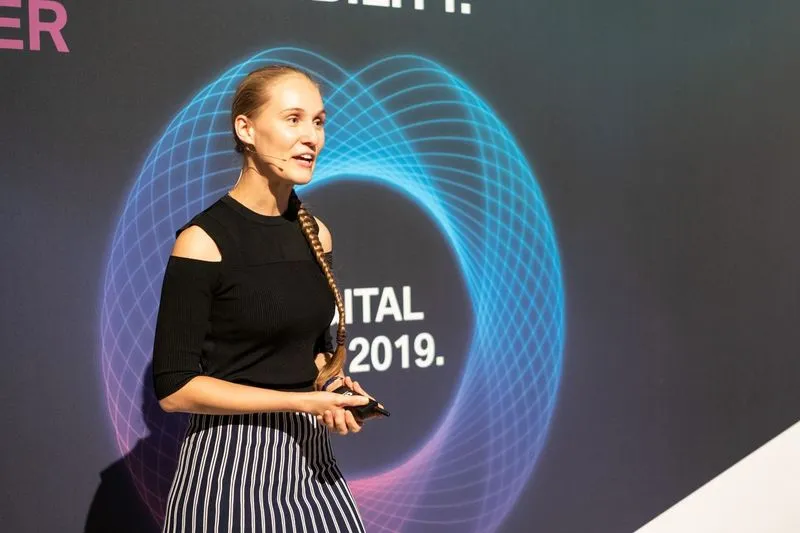
The Qwen App is a strong signal for leaders seeking to track China’s next digital interface. Ashley Dudarenok helps executives understand these shifts through China keynotes, advisory sessions, executive briefings, workshops, and trend research.
For teams assessing Alibaba AI, consumer platforms, AI commerce infrastructure, or China’s digital transformation, book a consultation to turn fast-moving signals into clear strategic action.
FAQs
Is Qwen Studio The Same As The Qwen App?
Yes, Qwen Studio is the consumer assistant experience associated with Qwen across official app listings. It focuses on everyday help, such as search, reasoning, multimodal understanding, creative work, coding support, and personal productivity.
How Do I Download The Alibaba Qwen App Outside China?
The safest route is to use the official Qwen download page or verified app store listings. Availability can vary by country, device, and account region, so users should avoid unofficial APK mirrors when possible.
Does Qwen AI Work In English?
Yes, Qwen Studio app listings show English support alongside multiple other languages. This makes the Qwen AI app more useful for global users testing Alibaba Qwen AI beyond Chinese language search and productivity tasks.
What Can The Qwen AI App Do Besides Chat?
Qwen Studio includes creative tools for image generation, image editing, video generation, document processing, and web search. For marketers, this makes it useful for fast ideation, content drafts, visual concepts, and research workflows.
Can Developers Use The Qwen AI Model Through Alibaba Cloud?
Yes, developers can access Qwen models through Alibaba Cloud Model Studio rather than using the consumer app. This route supports building AI products, internal agents, coding tools, and multimodal workflows with model-level controls.
Can Businesses Use The Qwen AI Model Commercially?
Many Qwen model releases are open source or open-weight, and Qwen3 technical reports describe Apache 2.0 licensing. Businesses should still confirm the exact license, model version, and deployment terms before commercial use.
What Privacy Questions Should Users Ask Before Using Qwen AI?
Users should check what data is collected, how account security works, and how uploaded files or prompts may be processed. This matters because AI assistants often handle personal, work, shopping, image, and document information.
What Is Tongyi Qianwen In Relation To Qwen AI?
Tongyi Qianwen is the broader Chinese name associated with Alibaba’s Qwen model family. For English-language audiences, Qwen is the shorter brand used across model releases, app experiences, developer platforms, and global AI communication.
How Could Qwen AI Glasses Change Alibaba’s AI Interface?
Qwen AI Glasses could move Alibaba’s assistant from screen-based prompts into hands-free voice and visual interaction. That would make the AI interface more useful for translation, navigation, note-taking, image Q&A, and real-world service moments.
How Does A Conversational AI Interface Change SEO For Brands?
A conversational AI interface may push SEO toward answer quality, structured product data, and reputation signals. Instead of optimizing only for search pages, brands need content that AI assistants can understand, compare, and trust.