
China’s ecommerce environment has changed rapidly in recent years. Product discovery now happens widely on Douyin, Xiaohongshu, and other content platforms where creators influence demand, reflecting the rapid rise of social commerce in China. When consumers reach the purchase stage, many still complete the transaction on Tmall China.
The platform provides a structured retail environment where brands operate verified stores, manage promotions, and control the final transaction experience. This structure explains why Tmall ecommerce remains central to brand strategy in 2026.
Social platforms generate interest. The Tmall platform converts that interest into purchases through brand-controlled retail infrastructure.
What Tmall Actually Is in the Alibaba Ecosystem
Alibaba’s commerce system is built around multiple consumer environments. The Taobao app serves as the primary entry point for shoppers to browse products, watch livestreams, and interact with merchants.
Within that ecosystem, Tmall marketplace serves a different purpose. It is a part of the system dedicated to established brands operating controlled retail stores. Consumers browsing Taobao traffic channels can move directly into brand-operated environments through Tmall ecommerce when they want to purchase branded goods.
Alibaba reinforced the platform’s importance in March 2025 by introducing expanded brand support policies. The company expanded commission rebates across product categories, extended the product incubation cycle from 30 days to 90 days, and upgraded marketing tools designed for product launches.
During the pilot program, Alibaba reported that around 90 percent of participating brands achieved double-digit sales growth.
Alibaba also disclosed the scale of its commerce ecosystem in 2025. Taobao and Tmall together reached 1 billion annual active consumers globally, while customer management revenue from Taobao and Tmall Group reached RMB 71.077 billion (US $9.95 billion) in the quarter ending March 2025, representing 12 percent year-over-year growth.
These figures show the commercial reach behind Tmall China and explain why brands continue to use the platform as a central retail channel.
In May 2025, Alibaba also announced a partnership with Xiaohongshu that allows users to move directly from content posts to product pages on Taobao and Tmall marketplace. This integration links social discovery with ecommerce transactions inside Alibaba’s retail infrastructure.
Brand Controlled Storefronts: The Structural Foundation of Tmall
Retail activity on Tmall China takes place in brand-operated stores. These stores allow companies to control product listings, promotional campaigns, and merchandising strategies within the Alibaba ecosystem.
Alibaba strengthened this model in 2025 through new brand support policies that expanded resources for merchant growth. The company increased marketing support and introduced improved tools designed for product launches and campaign management.
Performance during major retail events shows the impact of this store-based model. During the 2025 6.18 campaign, Alibaba reported that 453 brands on the Taobao and Tmall marketplaces generated more than RMB 100 million ($14 million) in gross merchandise value.
During the 2025 11.11 shopping festival, Alibaba said the event delivered the strongest growth in four years for its Taobao and Tmall commerce business.
Financial disclosures also show how brands operate commercially through these stores. In February 2025, Alibaba reported that customer management revenue from Taobao and Tmall totaled RMB 100.79 billion ($14.11 billion), up 9% year over year. The increase was supported by AI-based merchant marketing tools that help brands manage advertising and promotions through their Tmall store.
These systems allow companies to coordinate product launches, promotions, and campaign advertising from a single retail environment.
How Tmall Enforces Quality and Authenticity
Alibaba operates Tmall China under a governance framework that regulates merchants and protects consumers. Tmall has intensified its fight against counterfeits through three key strategies:
- Mandatory Traceability: High-risk products (e-bikes, gas stoves) now require unique “Trust Codes” verified at the source. Consumers scan via official channels to access national product data, eliminating mismatches.
- AI-Powered Governance: During 2025’s “618” festival, AI flagged 1.1 million misleading images in one week, issuing 410,000+ rectification notices. Full-process monitoring now governs live-streaming sales.
- Rigorous Lab Testing: Pre-Double 11, Tmall added 10 new testing labs, including the China Electronic Standardization Institute. Failed inspections mean removal, ranking demotion, or termination.
- Rewarding Quality: Initiatives like “National Selection” set quality benchmarks for cookware and apparel, while the “Thousand Stars Plan” offers traffic incentives for原创 (original) brands.
Results: Consumer complaints dropped 34.4% in 2025, with the rights index falling to 143—the first decline in three years.
Consumer Behavior: The Trust to Transaction Loop
Consumer behavior on Tmall in 2026 explains why the platform remains central to the purchase journey. The defining shift is the emergence of the “liquid” shopper—individuals who embody multiple personas depending on context.
Research identifies 20 new consumer profiles, where the same person can be a rational “Life Actuary” (50.4% of shoppers) calculating 极致质价比, then transform into an “Emotion Mender” buying purely for self-care. Categories like “emotional value” and “space transformation” are booming, proving consumers buy solutions for both rational and emotional needs.
Trust now drives transactions. Merchants with excellent service achieve repurchase rates twice those of poor-service sellers and net GMV twice as high. Quality has overtaken price as the primary driver of loyalty. Consumers use Tmall to verify a brand’s authenticity before committing.
This loop is operationalized through the “True Experience Score” (真实体验分). Stores scoring above 4.8 grew GMV at 2.2 times the rate of average stores. Brands like Tolue saw a 20% increase in repurchase rates by investing in service.
The verdict: every positive interaction adds a “trust token,” which the platform amplifies into greater visibility. Trust is no longer a compliance checkbox—it’s the fuel for sustainable growth.
Merchant Operations: What Running a Tmall Store Actually Requires
Running a Tmall store in 2026 is a capital-intensive operation demanding strategic precision across four core pillars: financial commitment, compliance rigor, service excellence, and data-driven marketing. These systems form the daily infrastructure where operational discipline determines whether traffic becomes a transaction.
1. Financial Reality: The Investment Floor
Although Tmall has reduced barriers by waiving annual fees and offering benefits such as short-term financing support, the idea of a “zero-cost startup” is misleading.
A new apparel store typically incurs first-month costs exceeding $1,400, including:
- Inventory: $1,400–$4,200
- Marketing tests: $420–$1,400+
Success depends on return on investment (ROI). Merchants must allocate capital carefully and optimize every dollar using performance data rather than relying on aggressive spending.
2. Compliance: Increasingly Strict Requirements
Tmall has significantly tightened compliance standards in 2026.
Key requirements include:
- Certified product qualifications for regulated categories (e.g., electronics must meet mandatory safety certifications)
- Full supply chain authorization for certain product types, especially in beauty and personal care
- Accurate product labeling standards, particularly in apparel (e.g., fabric composition must meet legal thresholds and testing verification)
- Higher deposit requirements for large appliances and high-value goods
Failure to meet these standards can result in product removal, ranking penalties, or store suspension.
3. Marketing and Traffic Acquisition
Brands generate visibility through Alibaba’s AI-driven advertising ecosystem.
Tools such as Quanzhantui optimize campaign performance across multiple traffic channels. These systems help merchants:
- Increase product exposure
- Allocate budget efficiently
- Optimize conversions through algorithmic targeting
Merchants coordinate advertising with major platform campaigns and use centralized dashboards to manage traffic and promotions in real time.
4. The “True Experience Score” Obsession
Since 2026, store performance has been heavily influenced by the True Experience Score, a system that evaluates overall customer satisfaction.
The updated scoring system places more weight on:
- Negative feedback rates
- Refund reasons
- Low-rating reviews (1–2 stars)
Stores scoring above 4.8 grow at 2.2x average rates. Platform data proves: merchants with excellent service achieve double repurchase rates and double net GMV.
5. Service = Growth Engine
Customer service is no longer a support function—it is a direct driver of growth.
Tmall now rewards merchants that provide:
- Integrated delivery and installation services (especially for furniture and appliances)
- Specialized support (e.g., expert consultations in categories like baby care or pet products)
- Fast and reliable shipping options
Certified customer service staff and real-time communication tools improve conversion rates by reducing uncertainty during purchase decisions.
6. Performance Monitoring & Incentives
Merchant dashboards track sales metrics and advertising performance, allowing real-time adjustments. For those who execute effectively, rewards can be substantial: top-performing stores earn up to $420,000 per quarter, more than double the previous year’s annual cap.
At the same time, Alibaba’s “Thousand Stars” program aims to develop 10,000 high-potential brands across multiple categories, with the goal of scaling 2,500 into industry leaders.
Strategic Role of Tmall for Global Brands in China
For global brands targeting China in 2026, Tmall has evolved far beyond a sales channel into a strategic partner for market entry, brand building, and sustainable growth. The platform’s role now encompasses four critical functions.
1. The Primary Gateway for Cross-Border Entry
Tmall remains the definitive entry point for international brands. In 2025 alone, 2,415 new international brands debuted on Tmall Global—averaging more than 6 per day from 52 countries and regions spanning the US, Japan, South Korea, France, Australia, and smaller markets like Cuba and Lithuania. Health, beauty, personal care, and maternal-child products lead the influx, with collectible toys emerging as the fastest-growing category.
To lower entry barriers, Tmall Global launched an English-language website in 2025, providing foreign brands with streamlined tools to open flagship stores and access direct import solutions such as Tmall Overseas Fulfillment (TOF). This infrastructure enables small and niche brands to test assortments before committing to a full-scale launch.
2. Growth Acceleration Through Platform Programs
For brands that demonstrate potential, Tmall offers structured pathways to scale. Participating brands can access the Tmall Innovation Center (TMIC) for co-development, New Brand Incubation marketing resources, and official live-streaming channels.
Results are tangible: in 2025, 564 potential brands became category first-place winners, and 180 merchants grew to industry leaders.
The Treasure New Brands initiative expanded from 500 to 2,000 partners in 2026, with over 500 Treasure New Brands achieving 35% 全年整体成交增长. Brands exceeding $14 million in sales increased 42%, with 31 surpassing $42 million and 12 entering the $70 million tier.
3. Crossover Innovation Catalyst
Tmall now functions as a crossover innovation incubator—identifying where consumer behavior has already blurred category lines and building infrastructure to make those intersections scalable.
Alibaba’s Databank aggregates behavioral signals to reveal latent intersections: for example, searches for “quiet desk lamps” combined with “focus-enhancing aromatherapy diffusers” triggered the “Deep Work Ecosystem Kits” vertical, which is now growing at 37% YoY.
Global brands leverage embedded tools such as “One-Click Compliance” for auto-generated EU CE, US FCC, and ASEAN documentation, and “Logistics Twin” simulations for customs clearance across 200+ country pairs. This infrastructure reduces time-to-validation from months to days.
4. The Trust Layer for Premium Positioning
Perhaps most critically, Tmall serves as China’s definitive “Source of Truth” for brand authenticity. For high-consideration categories, consumers use Tmall to verify official status and quality commitment before transacting. This trust layer enables premium positioning—brands that invest in service achieve double repurchase rates and double net GMV.
The platform’s 2026 consumer insights identify 20 distinct new profiles, including “anime spiritual shareholders” and “5-to-9 escape planners,” enabling precise targeting beyond demographics. Global brands like Adidas saw 25x sales growth through Chinese contemporary series co-created with Tmall 小黑盒, achieving a “see now, buy now”爆发.
The Future Role of Tmall in China’s Social Commerce System
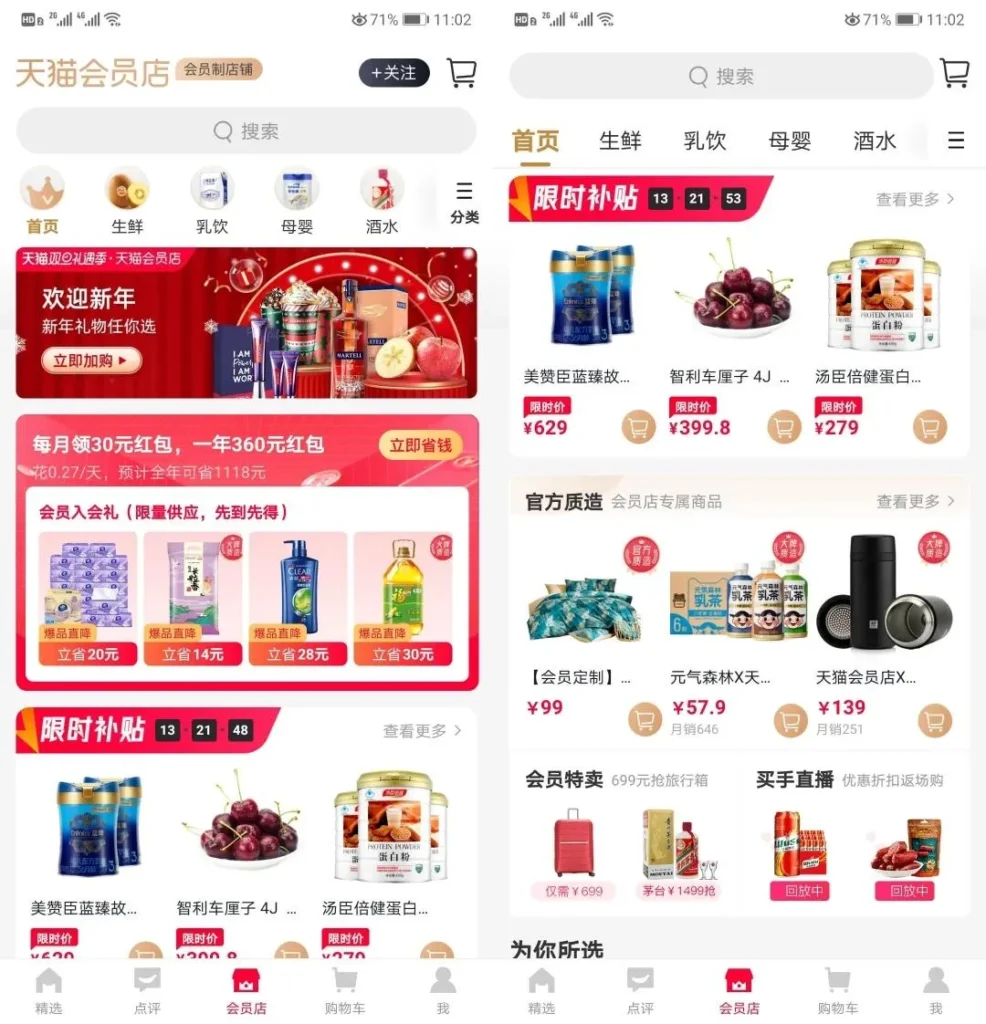
The evolution of China’s ecommerce environment continues to reshape how platforms interact with content ecosystems. In this environment, Tmall China is evolving from a traditional marketplace into a transaction infrastructure that works alongside social discovery platforms.
Deeper Integration with Content-Driven Discovery
Alibaba has begun strengthening connections between social content platforms and its retail ecosystem. In May 2025, the company announced a strategic partnership with Xiaohongshu that allows users to move directly from content posts to product pages inside Taobao and Tmall marketplaces.
This integration reflects a broader shift in the Chinese digital economy. Product discovery increasingly happens on content platforms, while purchase transactions often take place through structured retail systems such as Tmall ecommerce.
AI Tools Shaping Merchant Operations
Artificial intelligence is also becoming a larger part of the Tmall platform infrastructure. Alibaba’s 2025 financial disclosures highlight the role of AI-powered merchant tools for advertising optimization, campaign management, and product promotion.
These tools help brands analyze traffic patterns, improve product visibility, and refine promotional strategies inside their Tmall store.
Continued Role in China’s Retail Infrastructure
The future of Tmall China, therefore, lies in its ability to connect brand storefronts with wider digital ecosystems. Social platforms generate interest, while brand stores on the Tmall marketplace provide the infrastructure that supports payment processing, order management, and customer service.
As social commerce continues expanding, this combination of discovery and transaction infrastructure is likely to remain a defining feature of China’s ecommerce system.
Work With Ashley Dudarenok to Understand China’s Ecommerce Ecosystem
China’s digital commerce environment moves fast. Platforms such as Tmall China, Douyin, and Xiaohongshu operate within a connected ecosystem where social media, ecommerce infrastructure, and digital payments interact closely. For global brands, understanding how these systems work together requires clear market insight.
Ashley Dudarenok helps international companies understand how China’s digital economy functions in practice. She has spent more than fifteen years researching Chinese technology platforms, consumer behavior, and retail innovation.
What Ashley Dudarenok Provides
• Keynote presentations on China’s digital economy, retail innovation, and technology trends
• Executive briefings for leadership teams exploring China market opportunities
• Strategic advisory sessions on ecommerce, social commerce, and platform ecosystems
• Market insights on platforms such as Tmall marketplace, Douyin, and WeChat
Her work focuses on helping companies interpret China’s rapidly evolving digital landscape and translate those insights into practical business strategies.
If your organization wants to understand how Tmall ecommerce fits into China’s broader commerce ecosystem, you can book a keynote or strategy session with Ashley Dudarenok.
FAQs About Tmall China and Brand Ecommerce Strategy
What makes Tmall China different from other Chinese ecommerce platforms?
Tmall China operates as Alibaba’s business-to-consumer marketplace focused on established brands. Unlike open marketplaces, the platform hosts brand-operated stores where companies control product listings, pricing, and marketing campaigns.
Do brands need a local Chinese entity to sell on Tmall?
Not always. Brands can enter through cross-border channels such as Tmall Global or work with authorized partners that operate a Tmall store on their behalf. Many international companies start this way before establishing a local Chinese subsidiary.
Why do Chinese consumers trust Tmall brand stores?
Consumers often look for official Tmall flagship store pages because they represent the brand owner or an authorized partner. These stores provide verified product listings, structured customer service, and platform-managed dispute resolution.
Content platforms such as Xiaohongshu and Douyin often influence product discovery. Consumers read reviews or watch demonstrations before visiting a brand’s Tmall marketplace store to confirm product authenticity and complete the purchase.
What role do major shopping festivals play on Tmall?
Events such as the 6.18 campaign and the 11.11 Global Shopping Festival concentrate consumer demand and advertising activity. Many brands schedule product launches and promotional campaigns during these periods on Tmall ecommerce.
How do brands drive traffic to their Tmall stores?
Brands typically combine several methods. These include platform advertising tools, livestream commerce, influencer campaigns, and content partnerships that direct users to the brand’s Tmall store.
Can small brands succeed on Tmall?
Yes, although the platform is competitive. Smaller brands often focus on niche product categories, targeted advertising, and strong product storytelling within their Tmall store to build visibility.
How does Tmall address concerns about counterfeit products?
Alibaba operates intellectual property protection systems that allow brands to report counterfeit listings. The Tmall marketplace also enforces product compliance rules and can remove merchants that violate platform policies.
Why do international brands often launch products on Tmall first?
Many global brands use Tmall China as their primary ecommerce channel in China. The platform provides access to Alibaba’s consumer traffic, marketing tools, and payment infrastructure.
The platform increasingly connects with social discovery channels. Partnerships with content platforms allow consumers to move from social content to product pages on Tmall ecommerce, linking discovery with transactions.