
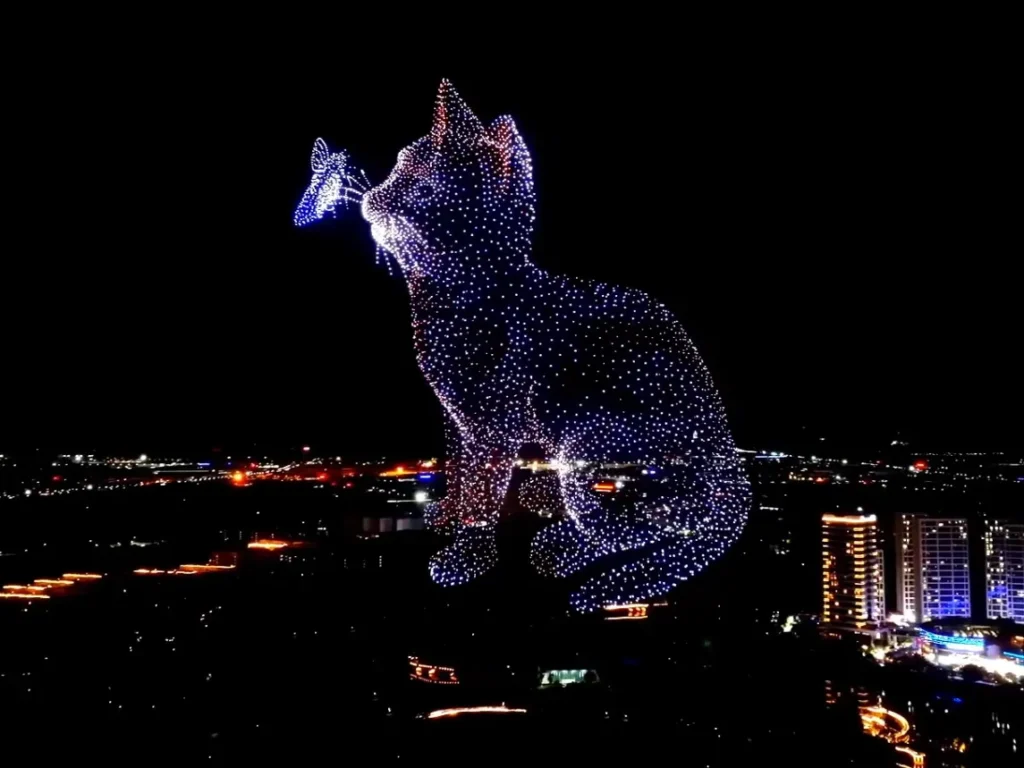
The race to create ever‑more arresting outdoor advertising experiences is unfolding above China’s cities. Instead of static billboards or illuminated skyscrapers, brands are turning to drone advertising platforms that carry lightweight LED screens and orchestrate coordinated light shows.
These airborne displays combine the scale of digital out-of-home advertising with the spectacle of aerial performances, and they sit at the intersection of China’s low‑altitude economy and its fast‑growing media market. As provincial governments invest in low‑altitude air corridors, landing sites, and 5G networks, they are creating the infrastructure for aerial advertising and other commercial drone services.
For marketers and investors who want to understand how this transformation is unfolding, it is essential to examine the policy context, technological innovations, and evolving business models that are turning the sky into a programmable media canvas.
Chongqing Shows How Drone Infrastructure Becomes Media Infrastructure
Chongqing has developed around twenty low-altitude application scenarios across inspection, logistics, tourism, and agriculture.
Its low-altitude infrastructure includes:
- 47 approved airspace zones
- 51 temporary takeoff and landing sites
- 26 visual flight routes
- 92.78 percent citywide airspace coverage
The city is already using drones in public operations. A 27-kilometer metro inspection now takes around ten minutes instead of fifty minutes. Inspection costs per kilometer have dropped by 31.6 percent, while efficiency has increased sixteenfold.
This infrastructure also supports commercial aerial advertising. Better airspace planning makes it easier to run drone light shows, flying displays, and brand activations at scale.
Chongqing’s 11,787 drone show, organized by the city’s broadcasting group and Damoda, gained Guinness World Records recognition.
The impact included:
- More than ten million spectators
- More than 40 million yuan in revenue
- Strong exposure for Chongqing’s city brand
- High social media amplification
For brands, Chongqing shows how drone light show advertising can combine public visibility, tourism value, and online reach.
Shenzhen Brings The Hardware Advantage
Shenzhen is one of China’s most important drone industry hubs. The city has roughly 1,900 low-altitude economy enterprises and plays a major role in global drone manufacturing.
Its strengths are clear:
- 70 percent of global consumer drones are produced in Shenzhen
- 50 percent of global industrial drones are produced there
- 1,284 low-altitude takeoff and landing sites have been built
- 23,000 5G base stations have been upgraded to 5G Advanced
Shenzhen has also passed China’s first local legislation focused on the low-altitude economy. This gives the city a stronger policy base for drone flights, aerial displays, and future drone advertising display services.
Tourism Is Turning Drone Shows Into City Media
The commercial impact is already visible in tourism and events. Chongqing’s record-breaking drone light show used 11,787 drones, attracted more than ten million spectators, and generated over 40 million yuan in revenue.
That makes aerial media valuable beyond brand visibility. It can support city marketing, night tourism, cultural festivals, and large-scale public events.
For local governments, drone shows create foot traffic and tourism value. For brands, they create social sharing, spectacle, and high recall.
Split this into two sections because one explains the technology, while the other explains the advertising use case. Here is a more skimmable version:
Flying LED Screens: Lightweight Engineering And Record-Breaking Innovation
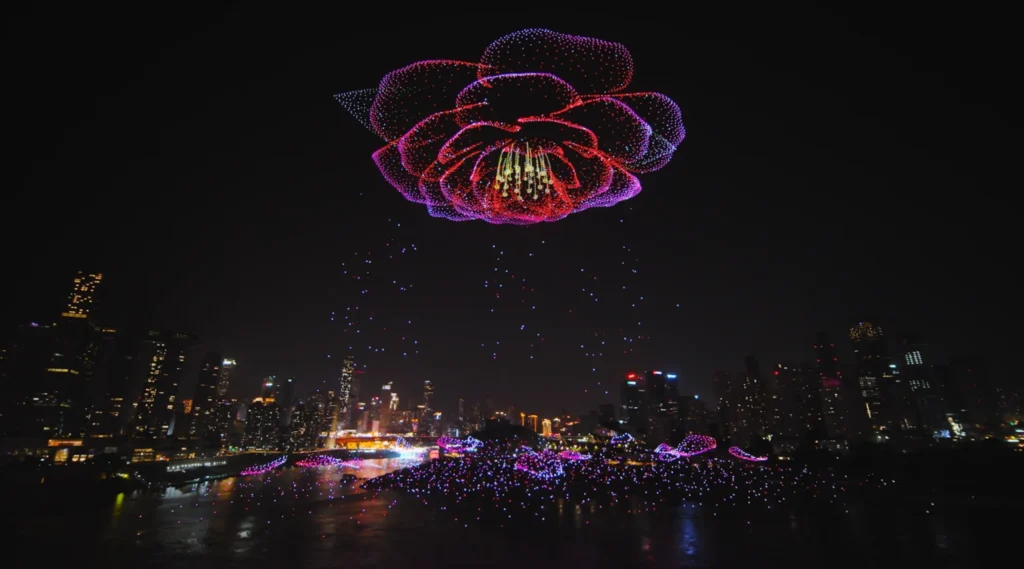
Flying LED screens are changing what drone advertising can look like. Instead of using drones only as points of light, brands can now display logos, videos, animations, and live content on large aerial screens.
The breakthrough comes from ultra-light LED mesh technology.
Filmbase Shows Why Weight Matters
Shenzhen-based Filmbase has developed a Flying Display built for aerial media. Its LED mesh display is lightweight, transparent, and flexible, designed for drone-based performance.
Key product features include:
- 250 grams per square meter
- 2 millimeters thick
- More than 95 percent transparency
- 5 x 15 meter screen size
- 75 square meters of aerial display space
- Modular linkage for up to 300 square meters
This matters because weight has always limited the use of drone advertising. A lighter drone LED screen allows drones to carry larger content in the air with better control and lower safety risk.
From LED Mesh To Drone Billboards
In 2025, Filmbase set a Guinness World Record when its 72.66 square meter mesh display flew over Shenzhen’s Longgang district.
The display was light enough for battery-powered flight and designed to resist moderate wind. This helped turn the screen into a real drone billboard, rather than a simple drone light formation.
This creates a new format between LED billboard advertising and aerial advertising. The screen can hover above stadiums, city centers, launch events, and tourism destinations.
Drone Light Shows As Experiential Digital Out Of Home Advertising
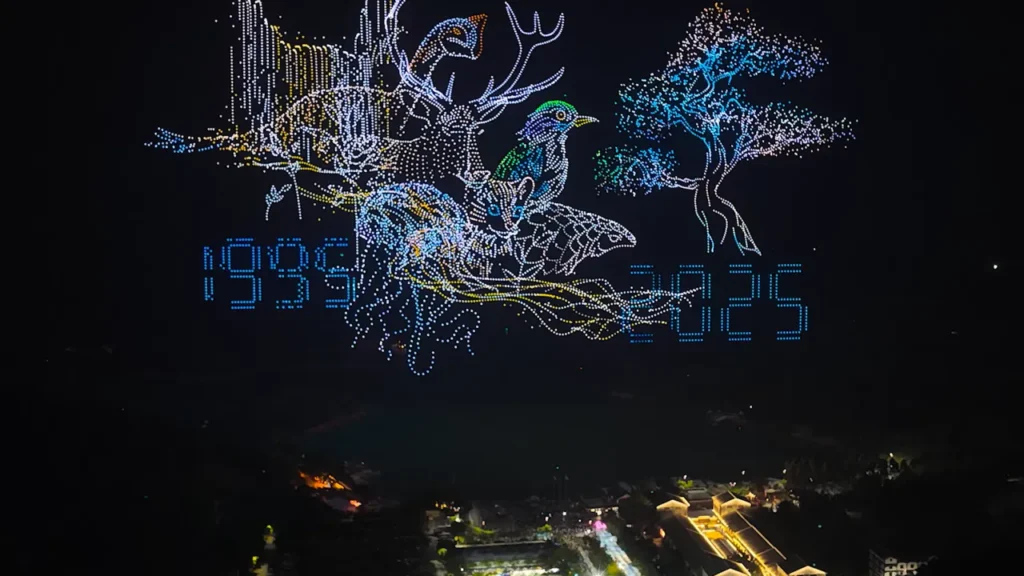
Drone light shows in China began as celebrations, product launch events, and tourist spectacles. Now they are becoming a form of digital out-of-home advertising.
The format works because it combines public visibility with social sharing. People watch the show in person and then share videos on WeChat, Douyin, Xiaohongshu, and other platforms.
Damoda Turns Drone Shows Into Scheduled Media
Damoda is one of China’s major commercial drone show operators. The company controls large drone fleets through automated systems and has worked with many international brands.
Its commercial scale includes:
- More than three million cumulative drone flight operations
- More than 1.5 billion brand impressions
- More than 200 international brand clients
This matters because drone advertising display campaigns can be planned like event media. A brand can use the sky for a launch, festival, city campaign, or national celebration..
Flying Displays Add Video, Live Content, And Brand Storytelling
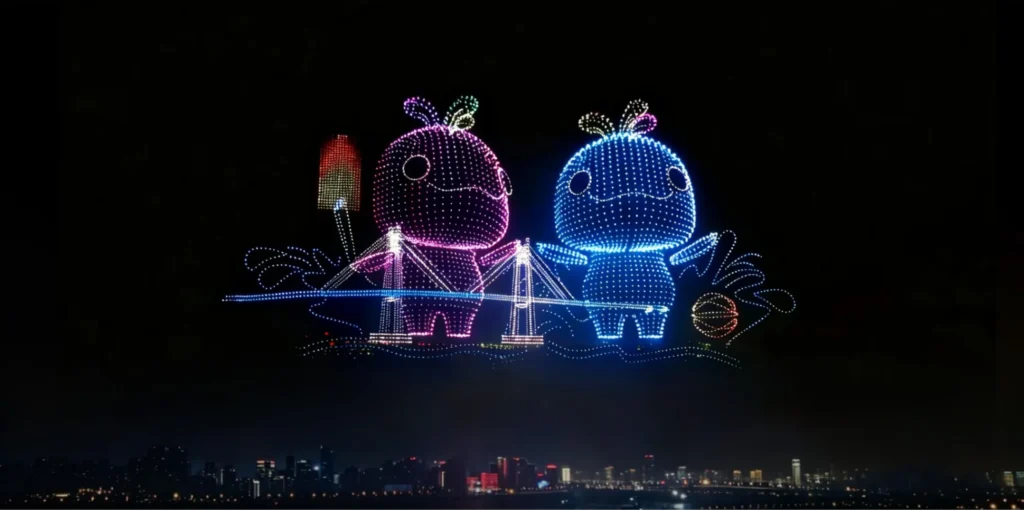

Filmbase’s Flying Display use cases show how aerial advertising services can go beyond light formations.
Possible use cases include:
- Cultural tourism night tours
- Concerts and festivals
- Product launches
- Sports events
- Live broadcast moments
- Synchronized ground and sky shows
At a Li Ning product launch, flying displays were suspended above the venue for a dramatic reveal. In another case, aerial screens broadcast basketball highlights in real time.
This is where drone advertising becomes more than spectacle. It becomes programmable media in the sky.
DOOH Market Trends: China in a Global Context
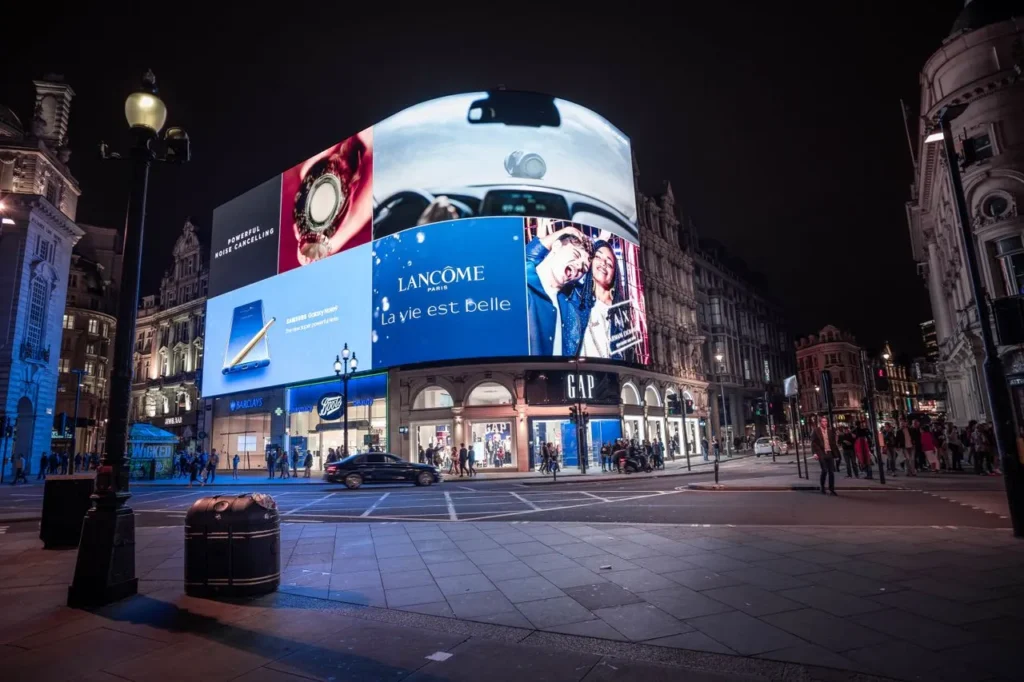
China’s DOOH ad spending reached USD 4.84 billion in 2025 and is projected to grow at a 6.57% CAGR to USD 6.65 billion by 2030. Urbanisation and digital infrastructure investments position China to remain the world’s largest DOOH market.
Global OOH revenues climbed to USD 54 billion in 2025, 15% higher than 2024, with the Asia-Pacific region contributing nearly 30% revenue growth. Digital OOH accounted for 47% of total OOH revenue, approaching the share of static formats.
The global OOH market surpassed USD 40 billion in 2025, with DOOH representing 30% to 40% of total OOH revenue in mature markets including the United States, United Kingdom, and Australia. The Broadsign 2026 trend report forecasts DOOH will account for 45.2% of total OOH ad spend by 2028, up from 22% in 2016. Programmatic DOOH spending is projected to reach billions by 2026.
Consumer response data reinforces the medium’s effectiveness. Nielsen research found that over 60% of OOH viewers take follow-up action. A joint OAAA and Google study showed 46% of people search online for a brand within 24 hours of seeing an OOH ad.
In the UK, DOOH spending within OOH reached 67% by Q3 2025, reflecting demand for programmatic targeting. These trends explain why advertisers are allocating more budget to digital out of home advertising and exploring new formats like led drone advertising.
Cost Considerations: LED Billboard Advertising vs. Drone Advertising
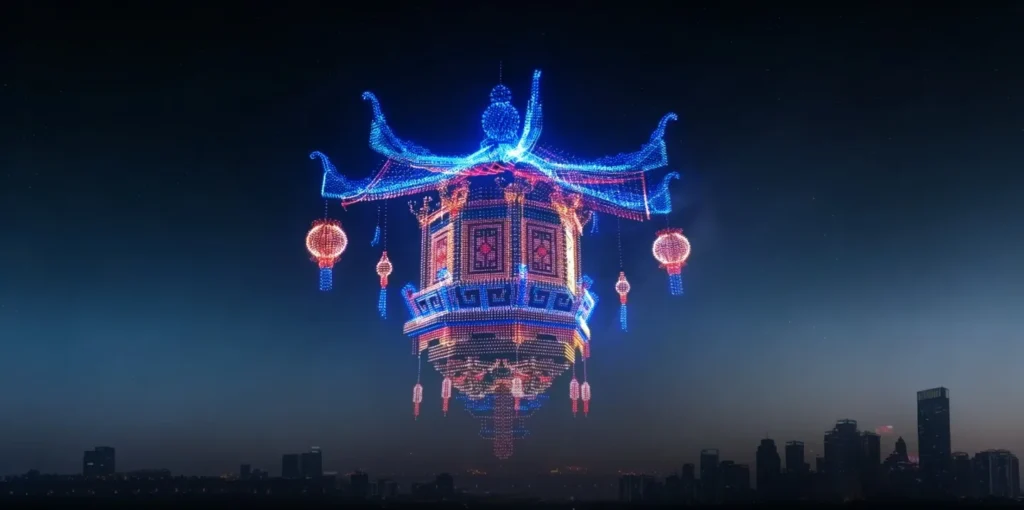
Cost remains a key factor when comparing traditional LED billboard advertising and emerging aerial formats. Electronic billboard campaigns can cost from a few hundred dollars to over USD 15,000 per month, with a national U.S. average of around USD 4,000.
Rates depend on location, size, duration, and demand, and premium locations in major cities command the highest prices. These boards offer continuous exposure but cannot easily create shareable moments or immersive experiences.
Drone light shows are more capital-intensive per minute but deliver spectacle and earned media. Sky Elements, a U.S. drone show provider, notes that small shows start around USD 20,000, medium shows around USD 40,000, and large shows can exceed USD 100,000.
Pricing factors include the number of drones, the length of the show, the complexity of the choreography, the location, and regulatory approvals. While these costs may seem high, clients are paying for attention rather than duration.
China’s aerial advertising industry benefits from economies of scale: Filmbase’s modular displays are lightweight and reusable, reducing setup costs over time. Damoda’s ability to manage thousands of drones from a single system lowers labor costs and enables standardized pricing for recurring shows. As drone hardware prices decline and battery technology improves, the cost per impression will continue to fall.
Future Outlook: Digital Out of Home Advertising Trends for 2026 and Beyond
Several trends will define digital out-of-home advertising in the next few years. Automation and data integration will continue to blur the lines between DOOH, connected TV, and mobile advertising. Programmatic buying will extend to drone shows, enabling brands to reserve flight corridors and dynamically schedule aerial displays.
Dynamic creative optimization will allow drone advertising content to adjust in real time based on audience demographics, weather, or event cues. Retail media networks will incorporate outdoor screens near stores, and these networks could be complemented by small‑scale flying displays that hover over shopping districts, drawing foot traffic.
China’s low‑altitude economy will likely expand further as more cities enact supportive policies. Shenzhen’s plan to achieve continuous 5G‑Advanced coverage below 120 meters and build more than 1,284 take‑off and landing sites suggests that aerial media could become a routine element of city life.
Meanwhile, record‑breaking innovations like Filmbase’s 300‑square‑meter flying display and Damoda’s high‑precision swarms indicate that the technical limitations of drone advertising display are rapidly receding. For global brands and investors, the strategic question is not whether to explore aerial advertising in China but how quickly to integrate it into broader marketing and innovation strategies.
Partner with Ashley Dudarenok
If you want to understand how drone advertising and digital out-of-home advertising can elevate your China marketing strategy, connect with Ashley Dudarenok. As a recognized China digital expert, Ashley can help brands plan immersive aerial campaigns, navigate regulatory environments, and integrate outdoor advertising in China into omnichannel strategies. Reach out today to explore how your next brand spectacle could light up the Chinese night sky.
Frequently Asked Questions
What is drone advertising, and how does it work in China?
Drone advertising uses unmanned aerial vehicles equipped with LED screens, banners, or light arrays to display brand messages in the sky. In China, flying LED screens and drone light shows are the most common formats, combining mobility with high visual impact.
How does a flying LED screen work?
A flying LED screen is a lightweight mesh display attached to drones or airships. It uses ultra‑thin LED film—often about 250 grams per square meter—and high‑transparency materials, allowing the sky to remain visible behind the content.
What is the famous drone company in China?
The most famous drone company in China is DJI, based in Shenzhen. Reuters describes DJI as the world’s largest drone maker and notes that it sells more than half of commercial drones in the U.S. market.
How big is the drone market in China?
China’s civil UAV sector reached 176.1 billion yuan, about USD 25.66 billion, in total output value in 2025. Industrial grade UAVs accounted for 125.9 billion yuan, while consumer grade UAVs reached 50.2 billion yuan. China also had nearly 3.29 million registered UAVs by the end of 2025, up 51 percent year on year.
What industries use aerial advertising services?
Sectors including consumer electronics, sportswear, tourism and government events use aerial advertising services. Case studies range from Li‑Ning product launches and smartphone releases to city cultural festivals.
What are drones used for in China’s low-altitude economy?
Drones are used for inspection, logistics, tourism, agriculture, cultural events, and emergency services. Chongqing alone has developed around 20 low-altitude application scenarios, which shows how drones are moving from novelty to everyday city operations.
How long can a drone LED screen stay airborne?
Current flying LED screens from Filmbase remain airborne for 20 to 30 minutes following two to three hours of charging. Battery technology continues to improve, with some drones offering up to 45 minutes of flight time.
What cities in China allow drone advertising?
Pilot cities include Shenzhen, Guangzhou, Chengdu, Chongqing, Shanghai, and Wenzhou. The national low-altitude flight authorisation system and pilot zones are expanding coverage. Approval processes vary by location.
Is drone advertising legal in China?
Yes. China passed revised aviation legislation in December 2025 regulating drone flights. Operators must obtain approvals from the Civil Aviation Administration of China and local authorities. The “Scan-to-Fly” initiative streamlines approvals in pilot zones.
Is programmatic DOOH relevant for drone advertising?
Yes. Programmatic buying tools allow advertisers to schedule DOOH campaigns based on audience data. As drone platforms become addressable, brands will be able to programmatically book drone advertising display slots