

Leaders often ask why a campaign that worked last year in China now feels flat. The answer sits inside Chinese consumer behavior as it plays out in 2026. The Chinese consumer reads signals across trust, value perception, identity, discovery, and convenience, and decides in minutes.
In 2025, China’s online retail sales reached RMB 15.97 trillion (about USD 2.22 trillion), up 8.6 percent from the prior year. Online sales of physical goods totaled RMB 13.09 trillion (about USD 1.82 trillion), accounting for 26.1 percent of total retail sales. At that scale, even small trust or service errors can multiply quickly once you increase the spend.
When teams copy a tactic like a KOL deal or a live stream format, they often copy the surface and miss the shift that made it persuasive. That gap shows up as unstable acquisition costs, weak repeat, and confused feedback from the market.
This article gives you a clear lens you can run before you commit to serious spending. So what is actually changing in 2026, and how do you test it quickly without over-investing?
Key Takeaways
Here’s a brief overview of the page:
- What Changed In 2026: Chinese consumer behavior is faster and more skeptical, with decisions shaped early by proof, service credibility, and clear expectations.
- Why This Matters At Scale: China’s 2025 online retail base is massive, so small trust, fulfillment, or after-sales failures can multiply quickly once spending increases.
- Six Trends Driving Decisions: Proof beats promise, value includes reassurance, feeds assign demand, identity is moment-based, repeat is not always loyalty, and convenience now means predictable certainty.
- What Causes These Shifts: Mobile-first usage, feed-driven discovery, tighter complaint systems, and platform rule design raise expectations for transparency and fair outcomes.
- What Leaders Misread: Attention is not the same as demand, older buyers are a growth driver, consumer centricity is an operational loop, and category context matters more than broad stereotypes.
- How Ashley Dudarenok Can Help: Ashley Dudarenok delivers tailored keynotes that translate these trends into a clear leadership lens for China market decisions and priorities.
Book Ashley Dudarenok for a tailored keynote.
What Is Changing in Chinese Consumer Behavior in 2026
In 2026, Chinese consumer behavior is defined by faster judgment and a higher bar for claims that feel believable. People scan for proof that matches lived experience, so clarity and service credibility shape decisions earlier than they used to.
This faster judgment happens inside a mobile-first market: as of June 2025, 99.4% of Chinese netizens access the internet via mobile, and online shopping penetration sits at 86.9% (975.52 million users).
Value is evaluated through outcomes and risk reduction, so brands win when they remove doubt before a buyer reaches the checkout. Discovery plays a larger role in many categories because demand can form during browsing, long before a person decides to search.
The Six Trends Shaping Chinese Consumer Decisions In 2026
The following shifts capture how the decision process is changing, and each one shows up clearly in the day-to-day buying behavior of Chinese customers.
Trend 1: Proof Beats Promise
People trust what they can check fast. They look for verified purchase reviews, real usage evidence, and visible service behavior before they accept a claim. Creator content still matters, yet it performs best when it demonstrates outcomes that feel repeatable.
This shift has matured because consumers have seen every persuasion format across categories. Skepticism is now a default filter, and brands get judged on how they handle real issues in plain sight.
This is reinforced by complaint pressure. In 2025 alone, consumer associations accepted 2,016,448 complaints and recovered RMB 925 million (approximately USD 134.9 million) in losses for consumers.
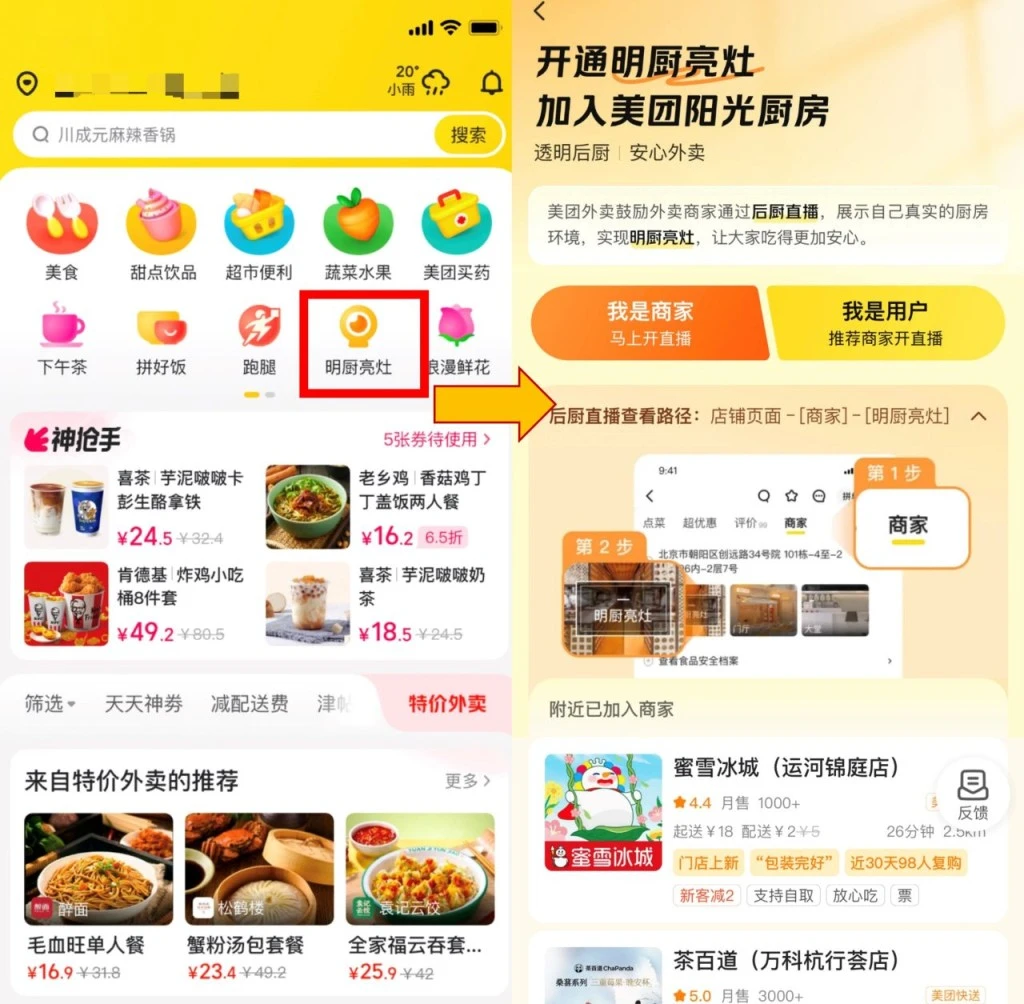
Example: In 2025, Meituan pushed “明厨亮灶” (Bright Kitchen, Clear Stove, open kitchen transparency) beyond a hygiene slogan into a scaled proof system. Instead of asking users to trust restaurant claims, Meituan created a dedicated traffic area for “阳光厨房” (Sunshine Kitchens, transparent kitchen program) where merchants broadcast live video from the kitchen.
By September 2025, Meituan reported close to 300,000 merchants connected to the program, with more than 150,000 merchants streaming steadily.
Why this matters is simple. Food safety is a classic trust problem because the consumer cannot verify it after the fact. A live kitchen feed changes that. When two restaurants offer similar dishes and prices, the deciding factor can become visible process cues, cleanliness habits, and staff behavior, all before an order is placed. Proof becomes the conversion mechanism, not a promise that asks for faith.
Trend 2: Value Becomes Outcome Plus Reassurance
Value is evaluated through results and confidence. Buyers look for durability, fit clarity, guarantee clarity, and return clarity, then decide if the trade feels sensible.
This is happening because trade-off thinking has become sharper. Consumers account for hidden costs like friction, regret, and time spent fixing a bad decision.
This isn’t just ‘price sensitivity.’ In 2025 complaint data, after-sales issues (27.68%) and contract issues (23.79%) dominated complaint types — a clear signal that reassurance and process clarity are part of perceived value.
Example: The 2025 tightening of “仅退款” (Refund Only, refund without return) is a clean signal that reassurance is now part of perceived value, and that systems correct when reassurance gets abused. In 2025, major platforms adjusted how “refund only” works, with reporting noting that platforms moved away from automatic intervention and refined the rule logic and process boundaries.
This matters because reassurance has a real economic cost when it becomes unconditional. Consumers may feel safer at first, yet abuse shifts losses onto merchants and distorts pricing and trust across the category.
In other words, value stops being a simple price comparison and becomes a judgment about fairness, process clarity, and resolution reliability. The platform experience itself becomes part of the product, and consumers learn to evaluate the system, not only the item.
Trend 3: Demand Is Assigned Through Feeds, Not Captured Through Search Alone
Many purchases begin with browsing and recommendation, then move into a quick decision once the outcome feels obvious. In consumer China, discovery often becomes the first touchpoint that shapes preference before intent is formed.
This is happening because recommendation systems are better at matching content to emerging needs. Content formats also compress the path from attention to purchase, so demand formation can start earlier than search.
By June 2025, short video penetration reached 95.1% of netizens, while search engine penetration was 69.2%. That’s why preference often forms upstream in feeds, and search frequently behaves as confirmation rather than the starting line.
Example: A 2025 live commerce industry report describes how data analysis and algorithm recommendations improve matching efficiency by connecting users with goods that align with behavioral signals rather than typed intent.
The practical outcome is that demand often begins as a surfaced scenario. A parent can see a clip that demonstrates a product outcome, then read comment threads that answer practical concerns, then purchase without starting from category search.
Trend 4: Identity Purchases Become Contextual And Micro Seasonal

People buy through roles and moments that shift across the week. Work, family, wellness, travel, and social settings each create a different standard for what feels relevant. Products that match the moment feel easier to justify and easier to share.
This is happening because daily life moves through more contexts and faster cues. Culture and commerce travel through short cycles, so relevance becomes situational.
Micro-seasonal culture moves through content cycles. By June 2025, micro-drama users reached 626 million (55.8% of netizens), showing how quickly ‘moment-based’ narratives can shape what feels relevant and shareable.
Example: In 2025, a Shanghai youth culture and tourism report described a shift from Citywalk toward Artwalk, with museums, galleries, and art venues becoming the anchor for scene-based consumption.
It reported that nearly eight in ten young visitors chose weekends for “逛馆” (museum hopping), and that more than half of those “逛馆” visitors came from outside Shanghai, which supports the idea that people will travel for a specific cultural moment, then build the rest of the spend around it.
What makes this a strong identity example is how the purchase logic changes by context. The report describes young people planning routes to capture “打卡” (check-in) angles and turning the experience into “社交货币” (social currency) through sharing.
That behavior pulls spending into micro seasons that rotate with exhibitions, pop-ups, and limited-time cultural programming, rather than stable seasonal calendars.
You can see the same pattern echoed in 2025 “国潮” (China chic) consumption scenes that have become everyday choices, such as “打卡文博场馆” (checking in at cultural venues), “体验汉服妆造” (Hanfu styling and makeup), and “入住国风酒店” (Chinese style themed hotels). These are identity purchases tied to a specific moment and setting, not a static demographic.
Why this matters: Identity in 2026 China is often situational. A consumer can be in “curated taste mode” on Saturday, “health and recovery mode” on Sunday, and “professional credibility mode” on Monday, and each mode triggers different proof needs and different value logic.
Brands win when they frame products around the moment and the setting that the consumer is actively living through, because that is how the identity cue becomes actionable.
Trend 5: Loyalty Is Being Rewritten, And Repeat Is Not Always Love
Repeat purchase can come from habit and low-friction reordering, even when emotional attachment is thin. Customer loyalty shows up when they advocate, return with confidence, and stick through a competitor wave.
This is happening because switching is easier across many categories, and consumers keep more options open. Consistency across the full experience now drives loyalty more than branding alone.
Example: In 2025, loyalty design leaned harder into convenience and friction reduction, not emotional attachment. On January 8, 2025, JD upgraded PLUS with “生活服务包” (Life Services Bundle, points redeemable for services like housekeeping and laundry) and added “180天只换不修” (180-day replacement instead of repair) for self-operated electronics. Reporting also notes expanded shipping benefits in faster delivery scenarios.
In August 2025, Taobao launched “淘宝大会员” (Taobao Big Membership), a unified membership system that connects Taobao with other Alibaba services such as Eleme and Fliggy.
The point is not brand love. The point is system gravity. A member repeats because the experience is smoother, the benefits are integrated, and switching feels like adding effort. That is repeat behavior, yet it can be thin loyalty if advocacy and trust do not deepen.
Trend 6: Convenience Becomes Friction-Free Certainty
Convenience is judged by predictability across delivery accuracy, return clarity, and support responsiveness. When the experience feels certain, hesitation drops, and repeat purchases become easier.
This is happening because expectations have been trained upward. Uncertainty now reads as risk, and risk slows decisions.
Example: In July 2025, Meituan reported instant retail daily orders hitting 150 million on July 12, with an average delivery time of 34 minutes. This is more than speed marketing. It industrializes predictability. When consumers can rely on fast delivery as a baseline, the expectation shifts from fast sometimes to reliable always.
Infrastructure data explains why the bar is so high. The People’s Bank of China’s 2025 third-quarter payment report states that banks processed 60.631 billion mobile payment transactions in the quarter, with RMB 137.53 trillion (about USD 19.14 trillion) in value.
When systems are clear at that volume, uncertainty in delivery promises or after-sales handling reads as avoidable risk, not normal friction. Convenience becomes certainty that reduces mental load, and certainty becomes the reason customers come back.
What Leaders Often Misread In 2026 And Why It Gets Expensive
China does not usually punish teams for moving fast. It punishes teams for explaining performance with the wrong story. A campaign can look strong on the surface, then decay when scale begins, because the interpretation was lazy.
The misreads below are common because they feel intuitive. They are also costly because they distort decisions on the budget, product, and service.
Misread 1: Treating Attention As Demand
Views and comments can rise for reasons that have little to do with purchase intent. Curiosity often behaves like entertainment. Purchase intent behaves like preparation.
The Chinese consumer signals intent through actions that reduce future effort, like saving a product, comparing it across contexts, asking practical questions, and returning after a day with a more specific concern.
When teams treat reach as demand, they scale into audiences that like the content and do not like the product. That is when you see rising returns, rising support contacts, and fragile repeat.
The stronger interpretation is behavioral. Look for signs of commitment, not only signs of interest. If commitment does not rise with attention, the creative is doing performance art, not persuasion.
Misread 2: Assuming Youth Is The Only Growth Lever

Youth culture remains influential, yet many categories are being reshaped by older buyers who purchase with purpose and expect stability. This group often anchors household spending decisions, influences family health choices, and values reliability over novelty.
They also evaluate trust through different cues, like service clarity, product safety, and outcomes that feel practical. Ignoring this audience narrows your growth map and can make you misjudge what value means in the category.
A better read is to treat age as a behavior lens. Look at who drives repeat, who drives fewer returns, and who drives steady basket building. Those patterns will often surprise teams that only chase the loudest culture signal.
Older buyers are not a niche. As of June 2025, netizens aged 60+ reached 161 million, and netizens aged 50+ made up 33.5% of all netizens. In many categories, this group anchors repeat, returns risk, and service expectations.
Misread 3: Thinking Consumer Centricity Means More Features
In China, consumer centricity is not a philosophy statement. It is a working loop between what people experience and what the business changes. It shows up in how returns reasons reshape product descriptions, how service transcripts reshape FAQs, and how recurring complaints trigger operational fixes within weeks, not quarters.
Brands lose the plot when they equate consumer focus with feature expansion. Feature growth without feedback discipline tends to add complexity and raise confusion.
The right read is operational. If customer feedback cannot change the offer, the content, and the service experience quickly, the brand is not consumer-led in any practical sense.
Misread 4: Treating China Like One Decision System
Many business plans fail because they assume one logic across categories and occasions. Beauty, grocery, parenting products, durables, and health oriented spend do not share the same evaluation process.
Even inside one category, self-use can behave differently from gifting, and weekday utility can behave differently from weekend identity. When teams apply one consumer story across every context, they create messaging that feels vague and offer structures that feel mismatched.
A better approach is to frame the buyer by decision context. Ask what problem is being solved in that moment, what proof matters in that moment, and what friction is most costly in that moment. Then validate within that context before you generalize.
How Ashley Dudarenok Helps Leadership Teams Decode Chinese Consumer Behavior

Chinese consumer behavior in 2026 is a test of leadership judgment. The market moves through signals that shift faster than playbooks, and the same tactic can produce opposite results across categories and moments.
Teams get into trouble when they treat visible formats as causes. They copy what they can see, then wonder why performance collapses at scale.
Ashley Dudarenok helps leadership teams read the system behind the behavior. She translates what buyers respond to into a clear lens across trust, value perception, identity, discovery, and convenience.
She also connects these signals to decisions leaders can control, such as what proof is required, where doubt enters the journey, how value is judged by outcomes and risk, and why service clarity now shapes growth outcomes.
The goal is practical. Leaders leave with a sharper way to interpret feedback, a cleaner way to prioritize what to fix, and a more disciplined approach to testing before investment grows.
If your team wants a clearer understanding of Chinese consumer behavior in 2026, book Ashley Dudarenok for a tailored keynote.
FAQs About China Consumer Trends in 2026 for Foreign Brands
What Is Changing in Chinese Consumer Behavior in 2026?
In 2026, Chinese consumer behavior is faster, more skeptical, and more service-led. People decide based on proof, fit, clarity, and after-sales certainty. Brands win by removing doubt early and matching real usage expectations.
What Are the Biggest China Consumer Trends in 2026 for Foreign Brands?
The biggest China consumer trends 2026 are practical value, trust visibility, and feed-driven discovery. Foreign brands grow when they localize proof, show reliable service, and tailor offers to moments like gifting, wellness, or family use.
How Do Chinese Consumers Evaluate Trust and Credibility Before Buying?
Chinese shoppers judge trust based on service credibility and on evidence they can quickly verify. They read reviews, watch real demonstrations, and check policy clarity. If delivery, returns, or support feel uncertain, they hesitate even with strong branding.
What Types of Proof Convert Best in China Right Now?
The best proof in China ecommerce is concrete and repeatable. Verified purchase reviews, before-and-after usage, creator demos that show steps, and visible customer service responses all convert. Proof works when it feels typical, not exceptional.
Which Customer Doubts Most Commonly Block Conversion in China, and How Do You Diagnose Them?
The most common conversion blockers in China are outcome uncertainty, fit confusion, and after-sales hassle. Diagnose them by reading reviews, chats, and return reasons for patterns. When the same doubt repeats across channels, answer it plainly.
How Do You Test Whether a KOL or KOC Campaign Will Scale in China?
To test KOL marketing at scale in China, start small and measure cohort quality, not views. Track saves, product page depth, repeat, and return rates by creator. If performance holds when you broaden audiences, the message is traveling.
What Does Outcome-Based Value Mean in the Chinese Market, and How Do Brands Communicate It?
In China, outcome-based value means the result feels predictable and low risk. Communicate it with clear use cases, measurable benefits, and simple guarantees. When buyers know what happens if it disappoints, higher pricing becomes easier to accept.
How Do Recommendation Feeds Influence Purchase Decisions in China Compared to Search?
Recommendation feeds shape preference before intent, while search often confirms a shortlist. In China discovery commerce, content can create need and resolve doubts in minutes. Brands should design creative for exploration, then make product pages close the decision quickly.
What Are the Best Ways to Test China Market Demand Quickly Without Overspending?
The safest way to test China market demand is fast, focused experiments. Run two messages, one offer, and one proof set, then compare retention, returns, and support contacts by cohort. If quality improves, scale gradually and keep testing.
How Can Brands Reduce Refunds and Returns in China Through Better Product Clarity and Expectations?
To reduce returns in China ecommerce, tighten expectations before checkout. Use clearer sizing, usage guidance, and realistic outcome examples, then reinforce policy clarity. When buyers feel informed and supported, impulsive purchases drop, and repeat confidence rises.
How Should Global Brands Localize Messaging for Different Chinese Customer Segments and Decision Contexts?
Localizing messaging for China starts with decision context, not translation. Map segments by use moment, gifting, self-use, family need, or status signal, then tailor proof and reassurance accordingly. If you are unsure, a local partner can validate faster.