
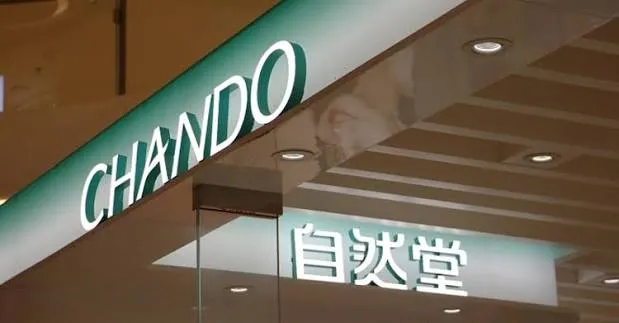
CHANDO became a major Chinese beauty brand by building a coordinated business around affordable skincare. Himalayan ingredients gave it a recognizable identity. Proprietary research, large-scale production, digital commerce, and extensive offline distribution helped turn that identity into a mass-market business.
Its growth shows how a domestic brand can translate local consumer knowledge into products, price points, and retail access that international beauty groups can find difficult to match.
Chinese Cultural Roots Shape CHANDO’s Brand Identity
CHANDO’s official brand story links its identity to Chinese ideas about harmony between people and nature. Its slogan, “你本来就很美,” translates as “You are beautiful just as you are.” This connects its natural-beauty positioning with confidence in individual appearance.
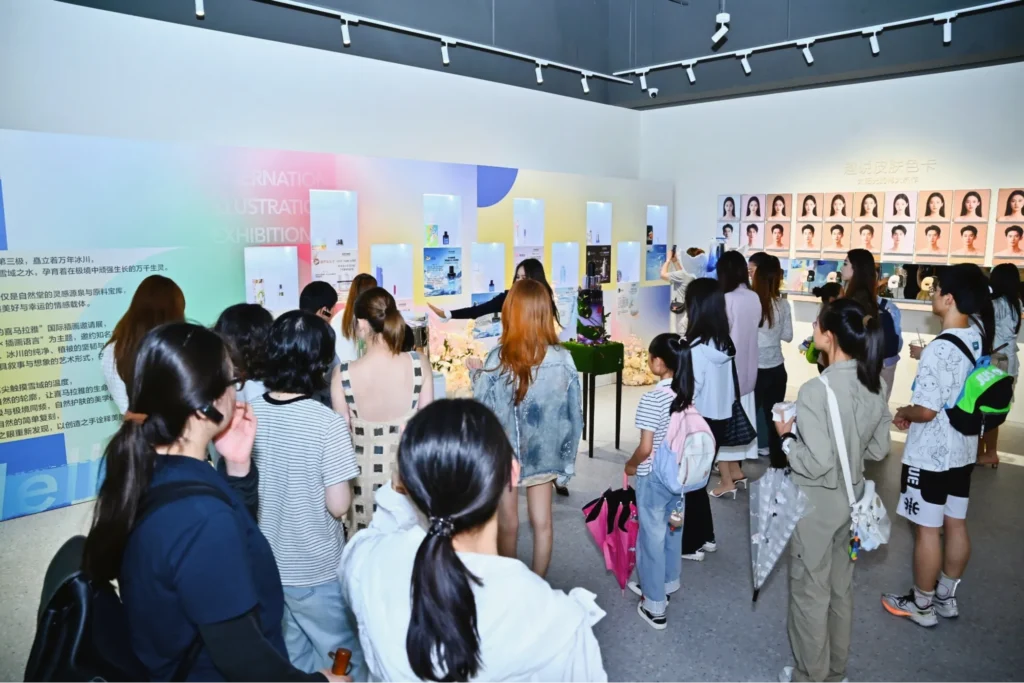
That identity also appears in contemporary creative work. At its June 2026 illustration exhibition in Shanghai, CHANDO Group presented artists’ interpretations of Himalayan mountains, glaciers, and alpine plants. Packaging from products such as Polar Glacier Water and Little Purple Stick Eye Essence served as canvases for artwork.
These collaborations connect CHANDO’s Himalayan identity with Shanghai’s creative community and extend its cultural expression into product design and public experiences.
CHANDO Himalaya Turned a Natural Story into an R&D Platform
CHANDO is the flagship brand of CHANDO Group, formerly JALA Group. The Shanghai company sells skincare, personal care, men’s care, and color cosmetics. Its April 2026 Hong Kong listing application reported 2025 revenue of RMB 5.32 billion.
The Himalayan positioning began with glacier water, alpine plants, minerals, and natural beauty. The stronger commercial move was to connect that origin story with proprietary ingredient development.
The listing filing identifies HiMurchaSin, a yeast ingredient developed from a strain found in the Himalayas, as proprietary. It appeared in 67 formulas, including Himalayan Essence and Time Frozen Essence.
The filing says in-house production costs about 95% less than buying comparable ingredients externally. This company-reported estimate helps explain the commercial value of proprietary research: ingredient ownership gives CHANDO more control over formulation, supply, and production costs.
The group’s current R&D disclosure reports 20 laboratories, 627 patent applications, 292 authorized patents, and more than 230 scientific and technical publications as of September 2026. These figures show the research infrastructure. Evidence for individual formulas and efficacy claims still needs separate assessment.
Research also sits within a much larger commercial budget. CHANDO Group spent RMB 106.2 million on R&D in 2025, equal to 2% of revenue. Sales and marketing costs reached RMB 3.04 billion, or 57.2%. Science supports differentiation, but reaching consumers costs far more.
Hero-Product Iteration Links Science to a Current Skin Concern
The Little Purple Bottle line shows how CHANDO turns research into successive product generations. The sixth-generation Time Frozen Essence had exceeded RMB 2.59 billion in cumulative retail sales by December 2025, according to the listing filing.
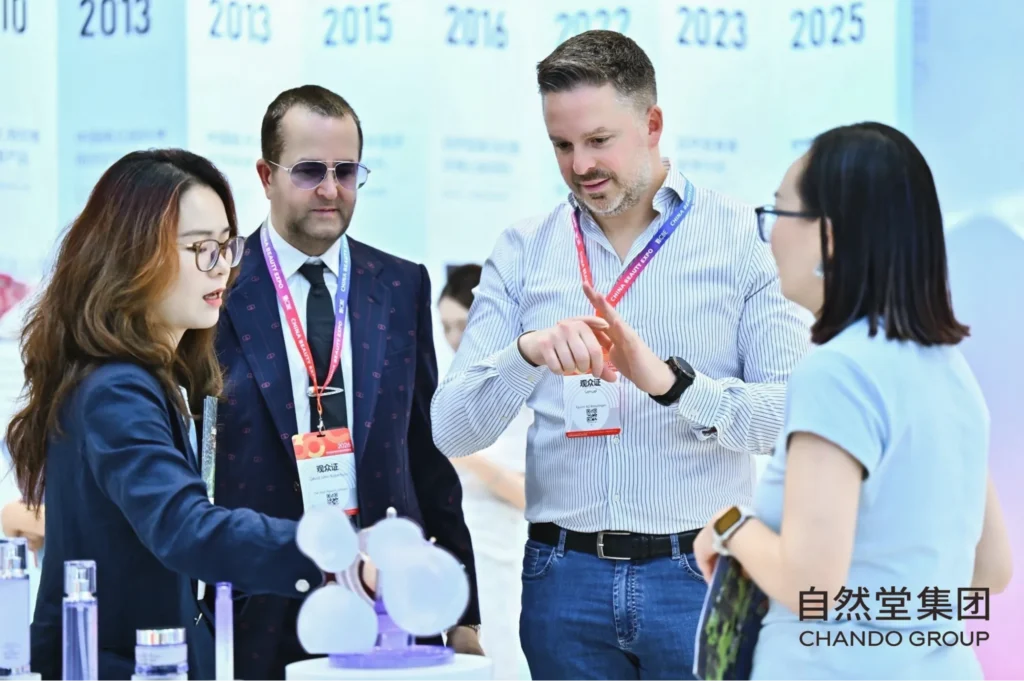
In April 2026, the company released the seventh generation with a self-developed peptide called HiMurchaS. CHANDO Group’s 2026 China Beauty Expo report links the product to “fatigue-induced aging,” a concern framed around stress, poor sleep, and reduced cellular energy. The company says it screened more than 2.8 million yeast proteins through an AI computational biology platform.
The filing says product development generally takes three to 18 months and begins with market analysis and consumer insight. Updating a familiar hero line lets the company introduce new ingredients while retaining the recognition built by earlier versions.
Manufacturing Scale Keeps Science Within Mass-Market Price Bands
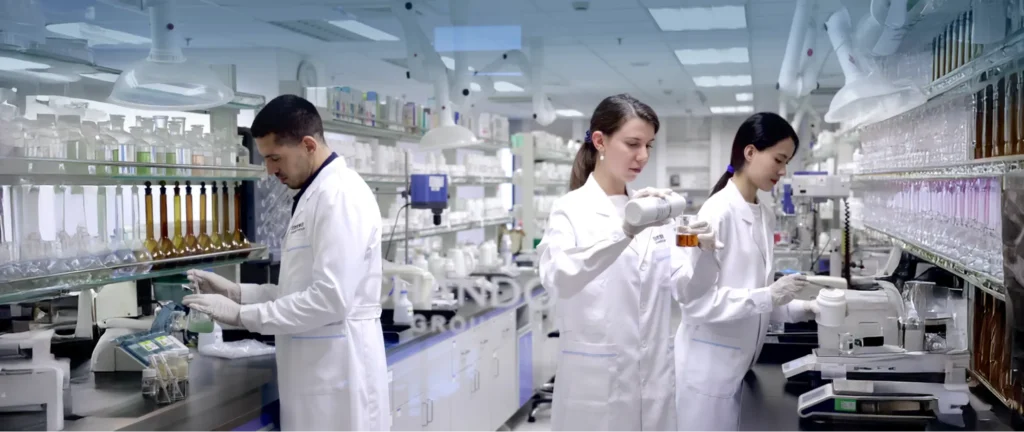
Ingredient research needs manufacturing capacity to reach consumers at scale. CHANDO operates finished-product facilities in Shanghai, an ingredient fermentation base in Shanghai, and a plant-processing base in Linzhi.
The third phase of its Shanghai cosmetics base began operating in October 2025 with a designed capacity of 8,007 tons a year. Its fermentation facility also began operations in 2025, with an annual ingredient capacity of 1,010.5 tons.
Across the Shanghai cosmetics production base, the filing reported:
- Designed capacity of 28,102 tons.
- Output of 25,627 tons.
- Capacity utilization of 91.2% in 2025.
These figures show substantial use of the production base alongside the addition of new facilities. Managing ingredient processing and finished-product manufacturing gives the group more direct oversight of production schedules, supply availability, and quality consistency.
Online Data and Offline Access Work as One Retail System
Online channels generated RMB 3.70 billion in 2025, equal to 69.5% of group revenue. Directly operated online stores alone contributed 56.5%. The network covers Tmall, Douyin, JD.com, Pinduoduo, Kuaishou, Xiaohongshu, and other platforms.
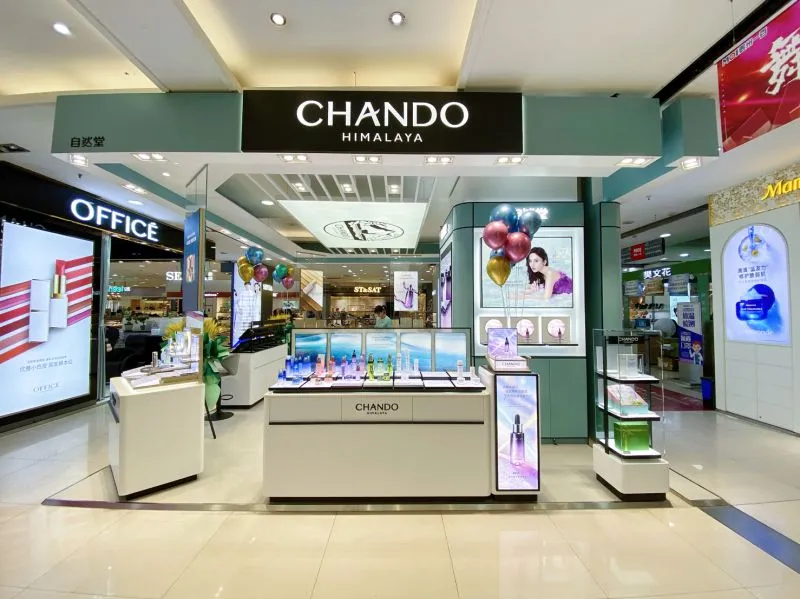
Offline reach remains substantial. The filing reports more than 64,800 retail sales points and a first directly operated flagship store in Shenzhen, opened in July 2025. Counters and local stores provide trials, advice, and immediate purchase access. E-commerce supports discovery, content, price comparison, and conversion.
Data connects those channels. CHANDO Group reported more than 42.5 million registered members at the end of 2025 and a 30.7% repurchase rate for registered CHANDO members. Its consumer management system combines online and offline records, while its cloud-store system synchronizes inventory and supports pickup or home delivery.
This coordination can help teams allocate stock, tailor membership offers, and connect online demand with local fulfillment. The membership figures indicate the size of the registered audience, although they do not establish loyalty across the entire customer base.
CHANDO Beauty Products Extend the Brand Beyond Facial Skincare
CHANDO shampoo is a smaller part of the portfolio. The current product catalog lists oil-control and volumizing shampoo alongside body wash, hair oils, skincare, masks, makeup, and men’s products. Personal-care revenue rose from RMB 172.6 million in 2024 to RMB 339.8 million in 2025, reaching 6.4% of group revenue.
Expansion into daily-use categories can create more purchase occasions. However, personal care remains a modest revenue contributor compared with the group’s core skincare business.
The strategic question is how far the brand can stretch. Each additional category needs a clear consumer purpose and a credible connection to its Himalayan science positioning. A wider catalog alone does not establish a stronger business.
What L’Oréal’s Stake Says About Global Beauty Competition
L’Oréal held a 6.67% interest in CHANDO Group through Beauty Park, according to the 2026 listing filing. Reuters reported that the stake cost RMB 442 million.
The investment gives an international beauty group financial exposure to a Chinese business with established distribution, smaller-city reach, and local product-development capabilities. It suggests that domestic competitors can also become investment opportunities for global beauty companies.
The stake does not establish a broad operating partnership or demonstrate overseas success. The filing says CHANDO Group has entered North American and Southeast Asian markets, but it does not provide regional revenue or market-share results.
The Strategic Takeaway from CHANDO
CHANDO’s next test is diversification. The group must reduce its 95.3% dependence on one brand while giving newer categories a clear role in the business. International expansion presents another challenge: establishing demand in markets with different consumer expectations, retail structures, and regulations.
For executives studying the company, the useful question is which capabilities can support that next phase. Progress will be easier to judge through revenue contributions from other brands, sustained category growth, and disclosed overseas performance.
Read China’s Beauty Shifts with Ashley Dudarenok

Ashley Dudarenok helps leadership teams interpret Chinese consumer behavior, cultural branding, and innovation to inform their business decisions. Her advisory, executive education, keynotes, workshops, and China learning expeditions connect developments in China with practical questions about products, positioning, and growth.
Book a consultation to explore what China’s beauty market means for your business.
FAQs
Is CHANDO Himalaya the same company as Himalaya Wellness?
No, CHANDO Himalaya is the international branding of China’s CHANDO beauty brand, while Himalaya Wellness is a separate company. Similar references to Himalayan ingredients do not indicate shared ownership, manufacturing, formulas, or distribution.
What does the name CHANDO mean?
The company says CHANDO comes from the transliteration of the Chinese “Chan Dao.” Its Chinese name, Ziran Tang, refers to a place where nature’s power gathers and supports the brand’s natural-beauty positioning.
Does L’Oréal own CHANDO?
L’Oréal is a minority investor, not the controlling owner. CHANDO Group’s 2026 listing application records a 6.67% interest through L’Oréal-owned Beauty Park. The founding family retains control through its holding structure.
Does CHANDO make shampoo?
Yes, CHANDO shampoo is part of the brand’s personal-care range, which includes oil-control, volumizing, and scalp-care products. Buyers should check the exact formula, hair concern, and authorized seller because ranges vary across markets.
Is CHANDO cruelty-free?
The official brand page says it does not conduct animal testing unless applicable law requires it. That qualification matters because regulations can differ across countries, product types, and time periods. Check the latest market-specific policy before purchasing.
Is CHANDO skincare suitable for sensitive skin?
Some CHANDO skincare lines target soothing, hydration, or sensitive-skin needs, but suitability depends on the individual formula and user. Review the full ingredient list, follow the directions, and patch-test before regular use.
How can buyers check if CHANDO beauty products are authentic?
Purchase CHANDO beauty products from official stores or authorized retailers. The company says product codes can provide batch and expiration information. Compare the seller, packaging, code, and local customer-service details before use.
What is CHANDO’s best-selling product?
The company identifies Pure Nutrient Lotion, also known as Bing Ji Shui, as its long-running best seller. Its 2026 filing reported cumulative sales of about 138 million bottles through December
Does CHANDO sell makeup and men’s products?
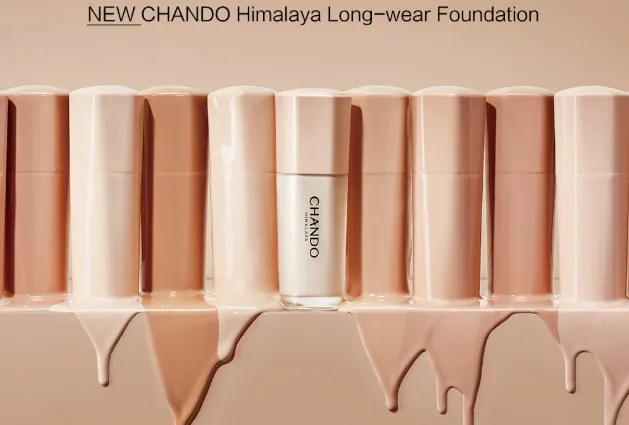
Yes, the current catalog includes foundation, cushion products, lip color, cleansers, and men’s hydration or oil-control products. Availability differs by country, so the official local catalog gives the most reliable current selection.
Are CHANDO skin care efficacy claims independently proven?
Evidence varies by product and claim. CHANDO reports laboratory research, patents, and clinical validation for certain ingredients, but buyers should not treat group-level R&D totals as proof for every formula or advertised result.