

Manufacturing in China is undergoing a profound transformation, shifting from a low-cost, labor-driven model to a technology-powered industrial system driven by AI, automation, and digital integration. Once known primarily as a source of low-cost labor and massive production scale, China is rapidly reinventing itself as a high-tech manufacturing powerhouse. Factories across the country are embracing automation, artificial intelligence (AI), and digital integration on an unprecedented scale.
The numbers tell part of the story: in 2024–2025, China accounted for over 54% of all new industrial robot installations globally and produced more than 70% of the world’s electric vehicles. These milestones underscore how technology – not cheap labor – is now at the core of China’s industrial competitiveness. Government initiatives such as “Made in China 2025” laid the groundwork for this shift, and today a wave of AI-augmented, green-energy-powered manufacturing is rewriting the playbook for factories in China.
This blog post explores how advanced technology is reshaping manufacturing in China, and what this means for industry executives, tech investors, policymakers, and global supply chains. From robotics on the factory floor to smart supply networks and green industrial parks, China’s manufacturing story is being rewritten – evolving from a labor-driven workshop into a technology-driven production system.
Manufacturing in China: From Labor Advantage to Technology Advantage
For decades, China’s edge in manufacturing was built on abundant, low-cost labor. Today, that labor advantage is giving way to a technology advantage. Rising wages and a shrinking workforce (China’s working-age population is projected to decline by over 100 million by 2040) have spurred a nationwide push to sustain productivity through automation and smart industry.
In other words, cheap labor is no longer the primary fuel for China’s factories – advanced machinery and digital systems are. This strategic pivot allows China to maintain its manufacturing dominance even as demographics shift.
By investing heavily in robotics, AI, and precision engineering, China is moving up the value chain and competing head-to-head with advanced economies on technology, not just on cost. The national strategy recognizes that modernizing production processes is essential to avoid stagnation. Policies like Made in China 2025 are explicitly aimed at upgrading the industry and avoiding the so-called middle-income trap through technological leapfrogging.
The result is that in 2025, Chinese manufacturing firms increasingly compete on innovation, quality, and efficiency rather than simply offering the lowest price. In short, China’s vast factory ecosystem is transitioning from being labor-driven to being innovation-driven, changing the fundamental narrative of “the world’s factory.”
Automation and Robotics in Manufacturing in China
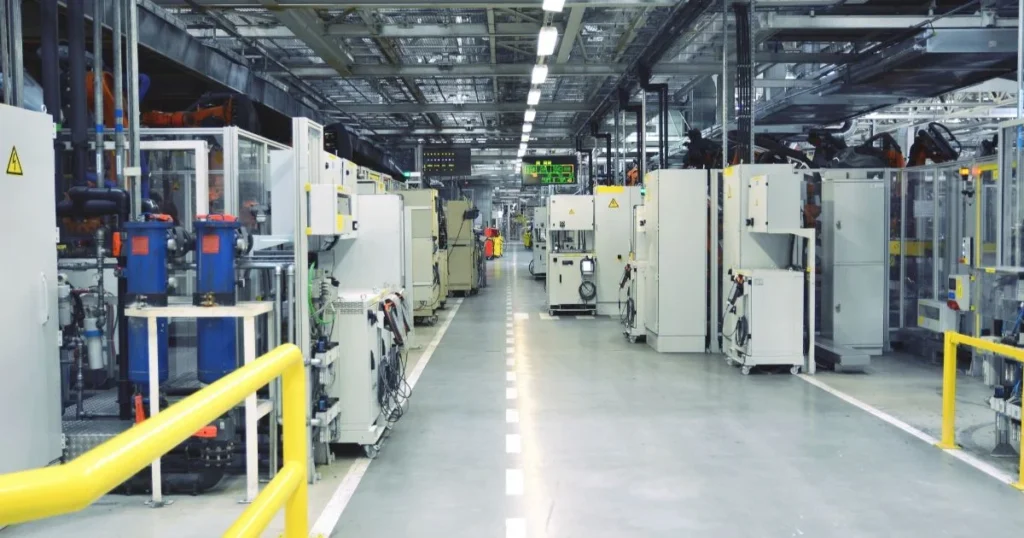
Automation has become a default assumption across manufacturing in China, particularly in automotive, electronics, and heavy industry. By 2024, the country’s industrial robot stock exceeded 2 million units, accounting for over half of all robots in use globally, with 295,000 new installations in a single year—the highest ever for one country. Automation is assumed wherever feasible to raise output, consistency, and cost efficiency.
Beyond heavy industrial robots, factories increasingly deploy collaborative robots for assembly, packaging, and inspection. Domestic suppliers now control over 52% of China’s robot market, including leadership in precision systems such as SCARA robots, enabling flexible and small-batch production.
Driven by labor shortages and rising costs, factories have adopted human–machine collaboration models and, in some cases, “dark factories” with minimal human presence. The result is lower unit costs, fewer bottlenecks, and more resilient manufacturing.
Artificial Intelligence in Manufacturing in China
Artificial intelligence functions as the control layer of China’s modern factories, guiding quality, maintenance, and production decisions through continuous data analysis.
Quality Control and Inspection
AI-driven visual inspection is now standard in advanced manufacturing hubs.
High-resolution cameras combined with machine-learning models scan products in real time, detecting defects invisible to human inspectors.
Impact:
- Automatic removal of faulty units from production lines
- Stronger quality consistency at scale
According to China’s Ministry of Industry and Information Technology (MIIT), “excellence-level” smart factories reduced defect rates by 50.2% using intelligent inspection systems. At BMW’s joint-venture plant in Shenyang, 200+ AI applications monitor production and final quality, enforcing standards that exceed industry norms.
Predictive Maintenance and Equipment Uptime
AI has replaced fixed maintenance schedules with predictive models.
How it works:
- Sensors track vibration, temperature, and electrical current
- AI models predict failures before breakdowns occur
- Maintenance is scheduled just in time
MIIT reports this approach increased production efficiency by 22.3% on average by reducing unplanned downtime. Dongfang Electric has further applied this model through China’s first industrial AI system for heavy equipment, providing precise digital maintenance guidance for power-generation assets.
Production Optimization and Flexibility
AI also optimizes entire production systems.
Examples:
- Chongqing appliance factory cut raw-material waste by 15% using AI-driven process control
- Wuhan-based PC manufacturer IPASON ships custom-configured orders within 24 hours using AI and IoT
Supported by China’s “AI + Manufacturing” initiative and digital-twin simulations, factories are evolving into self-optimizing systems where AI continuously improves efficiency, quality, and speed.
Smart Factories and Industrial IoT in China
National Scale of Smart Factory Adoption
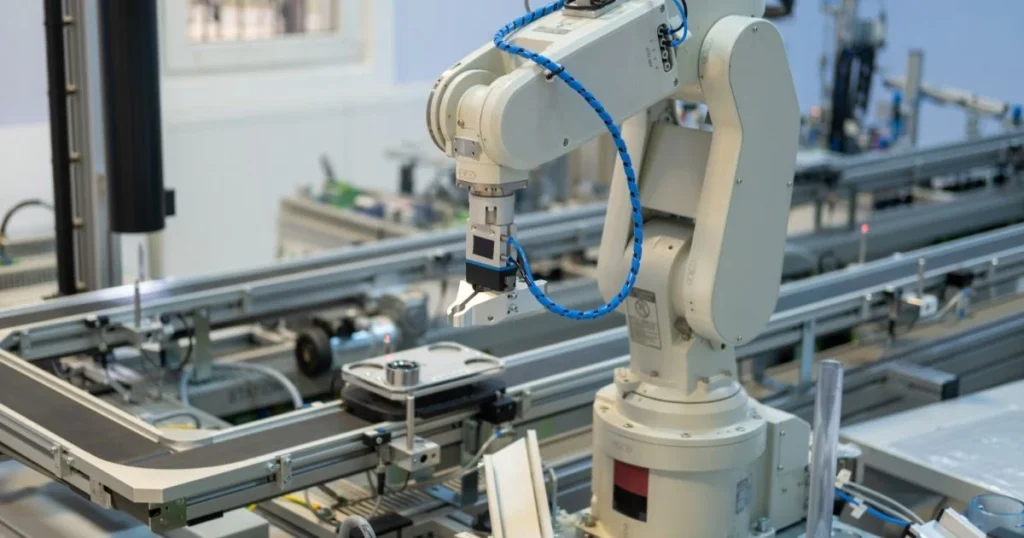
China’s smart factories represent a shift from automation to fully connected, intelligent production environments. These facilities integrate Industrial IoT sensors, networks, and software platforms to provide continuous visibility and control across operations.
As of early 2025, China had built more than 30,000 basic-level smart factories, alongside around 1,200 advanced and 230 excellence-level model factories, covering over 80% of manufacturing sectors nationwide.
This transformation is driven by MIIT’s smart factory gradient cultivation initiative, which upgrades factories in tiers rather than limiting digitization to large enterprises.
Data Integration and Real-Time Control
At the operational level, seamless data integration defines a smart factory. Sensors on machines, RFID-tagged materials, and industrial control systems continuously feed information into centralized platforms.
In advanced plants, digital control centers display live production status, yield rates, bottlenecks, and energy use. Issues become visible instantly, allowing managers to adjust schedules or reroute workflows before disruptions escalate.
Intelligence Embedded on the Shop Floor
Smart factories embed intelligence directly into physical systems. Workshops commonly deploy intelligent cranes coordinated with unmanned vehicles, multi-axis robotic arms performing precision tasks, and equipment that continuously reports performance data.
This shift is moving Chinese factories away from labor- and energy-intensive models toward data-driven, internet-coordinated operations, now seen as essential for sustaining industrial competitiveness.
Supply Chain and Logistics Integration
Smart manufacturing in China extends beyond individual facilities. Many manufacturers link factories with suppliers and distributors through industrial internet platforms. IoT signals automatically trigger parts replenishment, while smart warehouses and automated logistics synchronize production and distribution.
Among excellence-level factories alone, nearly 2,000 advanced application scenarios have been deployed, including integrated logistics systems.
Measurable Industrial Impact
The operational gains are significant. MIIT reports that excellence-level smart factories achieve, on average, 28.4% shorter product development cycles, 22.3% higher production efficiency, and 20.4% lower carbon emissions.
China now hosts over 40% of the world’s lighthouse factories, confirming that smart manufacturing has moved from pilot programs to large-scale execution.
Digital Twins and Simulation Technologies in China
Digital twin technology plays a central role in China’s shift toward intelligent, software-defined manufacturing.
What Digital Twins Mean for Manufacturing
Digital twins are virtual replicas of physical factories, production lines, or products. They operate in parallel with real-world manufacturing systems. These replicas use real-time data, sensors, and physics-based models. Their purpose is to test, optimize, and validate changes before physical execution.
China has promoted digital twins as a core pillar of intelligent manufacturing. Supportive policies under the 14th Five-Year Plan accelerated adoption and standardization. As a result, China’s digital twin market has grown rapidly. The market expanded at over 50% annually, exceeding ¥10 billion in 2022. It is projected to reach ¥37.5 billion by 2025.
Production Optimization Through Simulation
Manufacturers use digital twins to simulate entire production lines. Factories can test layout changes, machine settings, and workflow adjustments virtually. This avoids costly trial-and-error in live production environments.
AI algorithms can run thousands of scenarios on digital twins. They identify configurations that reduce cycle time and operational costs. This virtual testing significantly lowers innovation risk. Improvements can be implemented faster and with higher confidence.
Predictive Maintenance and Reliability
Digital twins continuously ingest real-time machine sensor data. AI analyzes this data to predict future performance and failure risks. If abnormal stress appears, engineers receive early warnings.
This method enables predictive maintenance instead of reactive repairs. Maintenance is scheduled before breakdowns occur. Both equipment lifespan and uptime improve as a result.
Training, Complex Testing, and Workforce Readiness
Digital twins enable testing of complex systems without halting production. In aerospace manufacturing, jet engine assembly can be simulated end-to-end. Fit, sequencing, and process risks are resolved digitally.
Workers can also train on virtual production lines. VR and interactive simulations improve safety and operational proficiency. One expert described digital twins as reflecting the entire lifecycle of equipment.
Technology Providers and Industrial Impact
Major Chinese firms like Alibaba Cloud and Huawei develop digital twin platforms. Telecom operators provide cloud and IoT infrastructure for large-scale simulations. Government pilot projects integrate digital twins into industrial parks.
In 2025, digital twins shifted from novelty to best practice. Manufacturers report shorter development cycles and higher first-time-right rates. Digital simulation is now a competitive advantage in Chinese manufacturing.
Advanced Manufacturing and High-Precision Production
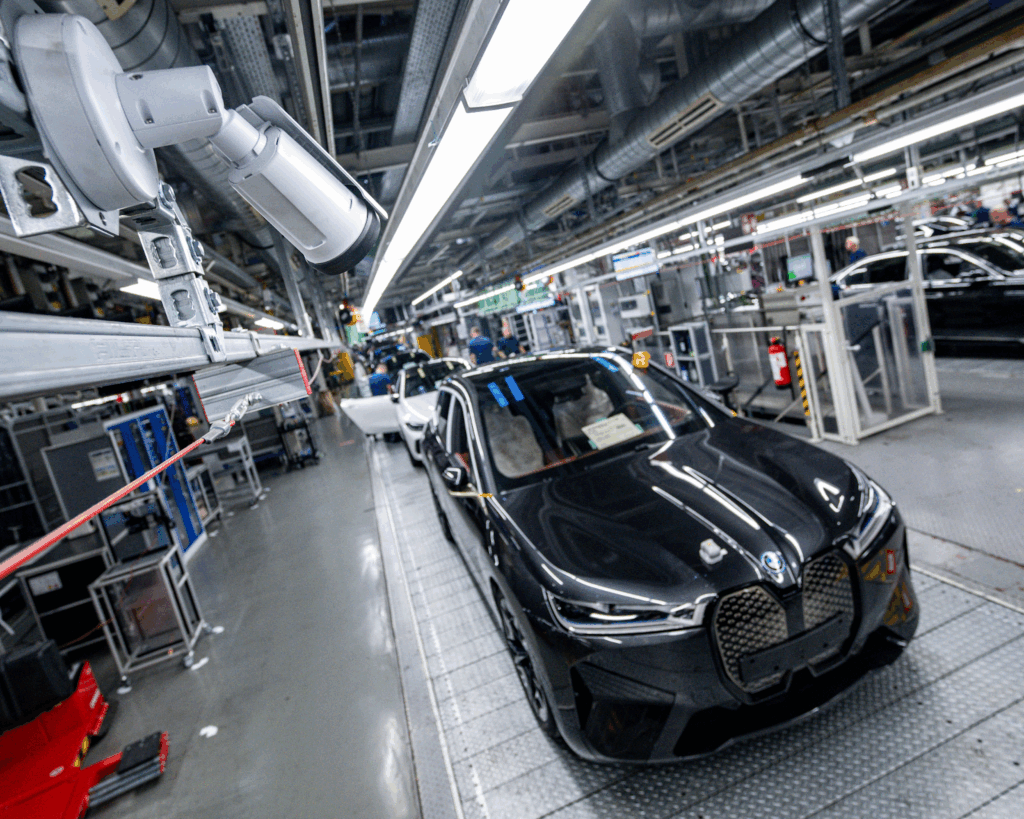
China’s manufacturing upgrade now emphasizes precision, customization, and advanced production techniques, not just output scale.
Shift From Volume to Precision
China’s transformation includes ultra-precise CNC machining, additive manufacturing, and customized production at scale. Over the past decade, China invested heavily in upgrading these advanced manufacturing capabilities.
Chinese firms achieved world-class performance in several high-tech domains. In rail equipment, China now sets all 13 international high-speed rail standards. In green energy, Chinese manufacturers dominate global solar panel and wind turbine production. By 2024, domestic automakers captured 90% of China’s NEV market, sourcing most components locally.
Gaps in Ultra-High-End Equipment
Despite progress, China still relies on imports for certain precision tools. These include advanced CNC machine tools and semiconductor fabrication equipment. Such tools are critical for aerospace components and leading-edge chip production.
This gap prompted policy responses under Made in China 2025. The strategy prioritizes domestic development of high-end CNC systems and lithography. Chinese machine tool builders now export globally, though frontier equipment remains challenging.
Precision Integration on Factory Floors
Chinese factories integrate advanced processes even when some equipment is imported. Multi-axis CNC centers, laser inspection, and advanced casting enable tight tolerances. Aerospace plants combine precision tools with digital manufacturing execution systems.
China hosts 79 lighthouse factories by 2024, many in automotive and electronics. These sites apply AI quality control and precision robotics at global benchmark levels. Facilities run by Bosch and Siemens in China demonstrate this convergence.
Additive Manufacturing and Customization
Additive manufacturing is a fast-growing strength for the Chinese industry. Chinese firms lead in printing large titanium aerospace parts and medical implants. Trade expos like TCT Asia highlight China’s expanding AM innovation ecosystem.
AM enables the production of complex geometries and shorter production lead times. This capability supports mass customization across industries.
Factories now handle high-mix, low-volume production efficiently. Automakers produce personalized vehicles on shared production lines. Consumer brands increasingly offer customized products using flexible systems.
Strategic Impact
China’s manufacturing upgrade focuses on precision, agility, and sophistication. Advanced tools enable rapid design changes and tailored production at scale. “Made in China” increasingly signals technical capability, not just volume.
Industrial Software and China’s Manufacturing Stack
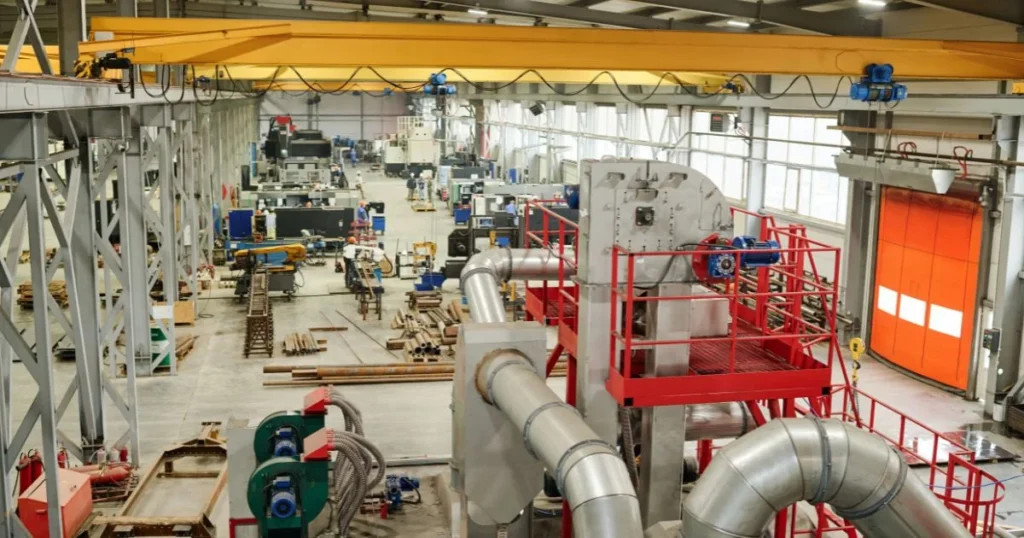
Industrial software forms the digital backbone that enables China’s factories to operate as integrated, intelligent systems.
Core Components of the Industrial Software Stack
China’s manufacturing stack includes MES, ERP, CAD, CAE, supply chain planning, and production analytics software. These systems coordinate production, connect operations with business management, and analyze factory data in real time. Historically, Chinese manufacturers relied heavily on foreign industrial software providers. In recent years, China has pushed strongly for domestic alternatives and wider software adoption.
The market impact is significant. China’s MES market reached ¥8.33 billion in 2025. It is projected to grow at 14% annually through 2033. Efficiency requirements, quality control, and complex production workflows drive demand.
Integration of Software and Hardware
A defining trend is the tight integration of industrial software with factory equipment. Machine tool manufacturers increasingly design equipment to integrate directly with MES platforms. MIIT promotes matching software developers with manufacturers to create tailored solutions.
Factories now deploy integrated digital stacks. MES monitors production in real time. AI analytics modules predict maintenance needs. ERP systems trigger material orders automatically when inventory runs low. This integration eliminates data silos and enables holistic optimization.
Building Domestic Software Champions
China views industrial software as a strategic capability. Reducing reliance on imported systems is a national priority. Government initiatives support domestic CAD, MES, ERP, and EDA software developers.
Chinese vendors compete by offering lower costs and China-specific features. Many platforms include bilingual interfaces and cloud deployment options. Competition has accelerated innovation, especially in AI and IoT integration. Some MES systems now include built-in AI quality analytics and mobile shop-floor dashboards.
Operational Impact on Factories
Factories increasingly operate through digital control systems rather than manual oversight. Real-time dashboards, traceability tools, and yield analytics are becoming standard. Adoption extends beyond large enterprises to mid-sized manufacturers.
Cloud-based MES and ERP lower barriers for smaller factories. Digital twin functionality is now embedded in many software platforms. AI supports scheduling, defect detection, and production optimization. Together, software and hardware form a manufacturing system that continuously learns and improves.
Government Policy and Infrastructure as Technology Catalysts
China’s manufacturing technology transformation is tightly driven by coordinated government policy and infrastructure investment.
National Industrial Strategy and Policy Direction
China has pursued a long-term, state-led strategy to upgrade manufacturing capabilities. The Made in China 2025 initiative launched this shift in 2015. It targeted technology self-reliance across ten priority manufacturing sectors.
By 2025, China reportedly achieved 86% of over 200 MIC2025 objectives. Successes include leadership in new energy vehicles and renewable energy equipment. Shortfalls in semiconductors and high-end machine tools prompted increased R&D funding.
AI and Manufacturing Policy Integration
AI policy further accelerated industrial transformation. The New Generation AI Development Plan identified manufacturing as a core application.
By 2025, “AI + Manufacturing” programs expanded nationwide. Shanghai released multi-year plans covering AI robotics, inspection, and digital twins. In August 2025, the State Council issued guidelines for deep “AI Plus” implementation. These policies aim for broad AI integration in key industries by 2027.
Infrastructure as an Enabler
Policy was reinforced by massive infrastructure deployment. China prioritized 5G, data centers, and industrial internet platforms under “new infrastructure.”
By late 2024, China installed over 4 million 5G base stations. 5G enables low-latency factory connectivity for IoT devices and autonomous systems. Industrial 5G applications now span 86 of 97 major economic sectors. More than 138,000 industrial 5G use cases are deployed nationwide.
Industrial Platforms, Incentives, and Standards
China targeted 120 influential industrial internet platforms by 2025. These platforms connect factories, suppliers, and logistics partners securely.
Governments also provided tax incentives and automation subsidies. Several provinces supported robot adoption by small and medium manufacturers. Nearly 500 national green and smart industrial parks now operate nationwide.
MIIT introduced smart factory grading standards. New policies promote zero-carbon factories and near-zero-emission industrial parks.
Strategic Impact
Policy alignment reduced risk for large-scale technology investment. Manufacturing upgrades became incentivized rather than optional. China’s policy-driven model sharply accelerated technology adoption timelines.
Sustainability, Energy Efficiency, and Green Manufacturing
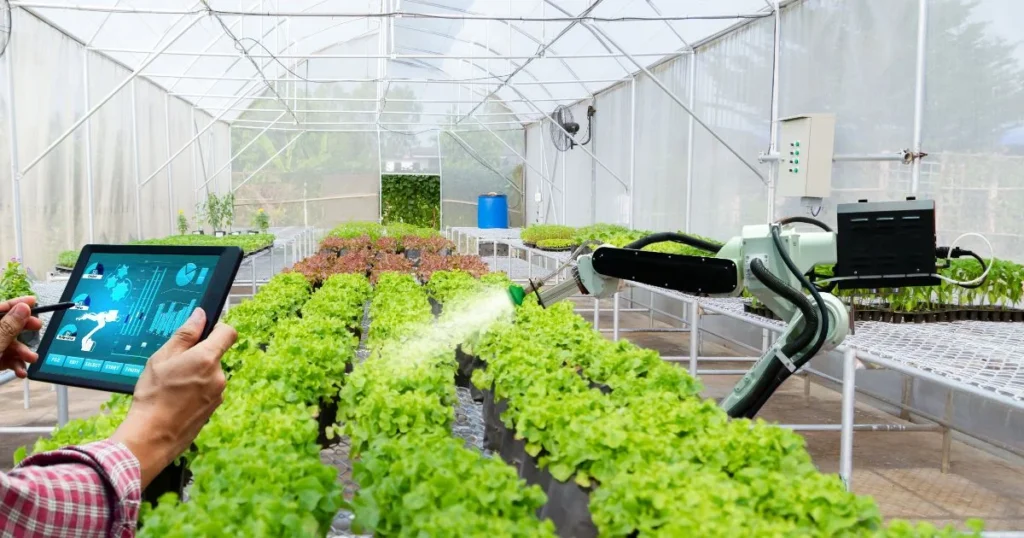
Sustainability has become a core objective of China’s technology-driven manufacturing transformation.
Policy Drivers and Strategic Commitments
China’s green manufacturing push is driven by policy and economic incentives. The country pledged to peak carbon emissions by 2030 and reach neutrality by 2060. These targets shape industrial policy and technology investment priorities.
Programs promoting green factories and zero-carbon industrial parks have expanded nationwide. Technology adoption is central to meeting these environmental goals.
Smart Energy Management in Factories
Energy efficiency is a primary focus of green manufacturing upgrades. Smart factories deploy energy sensors and digital management systems.
At Michelin’s Shenyang tire plant, a digital energy system tracks electricity, gas, and water usage. Real-time analysis identifies inefficiencies and peak consumption periods. Since 2021, the plant has used 100% renewable electricity. This approach could reduce emissions by 800,000 tonnes over 20 years.
At Suzhou Industrial Park, AI forecasts energy demand using production schedules. The system prioritizes renewable sources like solar and wind. In 2024, over 90% of the park’s energy came from clean sources.
Emissions Monitoring and Compliance
Technology also strengthens emissions tracking and regulatory compliance. Factories use IoT systems to monitor carbon and pollutant outputs.
Production, energy use, emissions, and waste data feed into unified platforms. This integration breaks silos between production and environmental management. Factories can adjust processes instantly to meet emissions targets.
By 2025, China certified nearly 500 national green industrial parks. Thousands of factories meet defined green manufacturing standards. Waste utilization rates in these parks exceed 95%.
Circular Manufacturing and Resource Efficiency
Digital tools support circular manufacturing practices. Sensors assess scrap quality and route reusable material automatically. MES systems coordinate reprocessing and waste reuse.
Industrial parks share by-products across facilities using digital platforms. IoT-managed heat recovery systems reuse waste heat efficiently. Additive manufacturing reduces material waste and supports reuse.
Strategic Impact
Digital technology aligns productivity gains with environmental performance. Green manufacturing is now an operational requirement, not a pilot concept. China’s factories increasingly combine efficiency, compliance, and sustainability at scale.
How Global Companies Are Adapting Their China Manufacturing Strategy
China’s manufacturing transformation is reshaping how multinational companies design their operations in China.
From Low-Cost Assembly to Advanced Manufacturing
Global companies no longer view China as a basic assembly base. Many now position China as a hub for high-tech manufacturing and innovation.
Firms like BMW, Siemens, and ABB invested heavily in smart factories in China. BMW’s China plants rank among its most advanced globally. Some body shops achieve up to 95% automation. AI systems are embedded across production and quality control.
ABB opened a $150 million robotics mega-factory in Shanghai. The facility uses AI-driven systems to manufacture next-generation robots. These investments signal confidence in China’s advanced manufacturing ecosystem.
Localization of Innovation and R&D
Multinationals increasingly localize innovation inside China. Many expanded China-based R&D centers to access engineering talent.
Toyota partnered with BYD to develop the bZ3 electric vehicle. The model uses BYD’s locally developed battery technology. This collaboration accelerated Toyota’s EV rollout in China.
Industrial firms co-develop digital solutions with Chinese clients and startups. Software and automation tools are tailored to China’s scale and speed. Some innovations developed in China are later deployed globally.
Operational Strategy Adjustments
Foreign firms must now match Chinese competitors on efficiency and speed. Automation levels in China plants often exceed those elsewhere.
Electronics manufacturers increased robotics use in Shenzhen and Chengdu. The goal is to remain cost-competitive with highly automated Chinese rivals. Some firms focus China operations on high-value or precision products.
Supply chains are also localizing. Companies integrate with digitally enabled Chinese suppliers. China-based engineers increasingly lead AI and automation initiatives.
Constraints and Strategic Tradeoffs
Companies must navigate data localization and cybersecurity regulations. Competition from advanced Chinese firms has intensified across sectors.
Despite challenges, high-tech investment continues. FDI increasingly targets EVs, automation, renewables, and healthcare technology.
Strategic Impact
Multinationals increasingly adopt a “do as China does” approach. China’s operations now function as engines of innovation and efficiency. Foreign firms are participants, not observers, in China’s manufacturing upgrade.
What This Transformation Means for Global Supply Chains
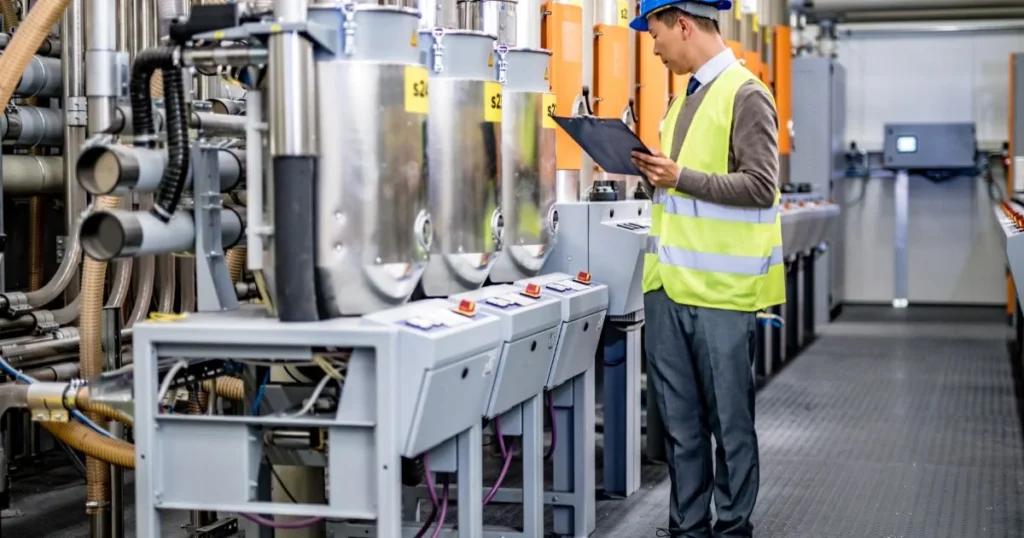
China’s manufacturing upgrade is reshaping how global supply chains are structured, managed, and diversified.
Rising Dependence on Advanced Chinese Manufacturing
China’s move up the value chain increased its role in high-tech global supply chains. The transformation of manufacturing in China is reshaping global supply chains, particularly in electric vehicles, batteries, and green technologies.
Global automakers increasingly source EV batteries and drivetrains from China. China’s scale creates cost advantages that are difficult to replicate elsewhere.
In the first nine months of 2025, Chinese EV exports reached $48 billion. Electric vehicles were shipped to over 200 countries.
Diversification and the Limits of “China+1”
Companies are diversifying supply chains to reduce geopolitical and disruption risks.
Many adopt “China+1” strategies by adding production in Southeast Asia or India.
However, China’s industrial depth remains hard to replace.
High-tech manufacturing ecosystems are deeply concentrated in China’s coastal regions.
The Yangtze River Delta and Greater Bay Area host dense supplier and innovation clusters.
Even diversified assembly often depends on China for components and engineering support.
Faster Supply Chains and New Expectations
China’s digital factories have raised global expectations for speed and flexibility. Some Chinese factories deliver customized products within 24 hours.
Global firms now adopt AI forecasting and IoT tracking to match this pace. Supply chain control towers and digital platforms are becoming standard tools. Chinese logistics and manufacturing practices increasingly influence global norms.
Export of China’s Manufacturing Model
Chinese manufacturers are expanding production overseas. Automated factories are being built in Southeast Asia and Eastern Europe.
Chinese firms often bring suppliers with them. New manufacturing clusters replicate China’s domestic ecosystem model. This spreads China’s technology-driven manufacturing approach globally.
Strategic Implications
Global supply chains face a strategic paradox. China’s products are more essential, yet diversification pressures are rising. Most firms pursue dual strategies. They leverage China’s strengths while building resilience elsewhere.
China will likely continue setting benchmarks for manufacturing efficiency. Global supply chains are adapting around China’s capabilities, not abandoning them.
Common Misconceptions About Manufacturing Technology in China
Many misconceptions about manufacturing in China persist, despite the country’s leadership in robotics, smart factories, and industrial AI.
Misconception 1: Chinese factories are low-tech and labor-intensive
China is now a global leader in factory automation and smart manufacturing. It has installed more industrial robots than any other country for twelve consecutive years.
In 2024, Chinese factories added about 295,000 new robots. That accounted for over half of global robot installations. Robots now operate across 71 major industries and 236 sub-sectors.
China’s robot density ranks third globally, behind South Korea and Singapore. Many factories now operate lights-out production with minimal human intervention.
Misconception 2: Chinese manufacturing quality is inherently low
Product quality has improved significantly with the adoption of advanced technology. AI inspection systems and precision sensors detect defects that humans often miss. Top-tier smart factories cut defect rates by around 50% on average. International quality standards are routinely met or exceeded.
BMW’s Shenyang plant follows quality systems exceeding industry norms. China hosts 79 World Economic Forum Lighthouse Factories, about 42% of the total globally.
Misconception 3: China only copies manufacturing technologies
China is increasingly innovating in manufacturing technologies. In 2024, it accounted for about two-thirds of global robotics patent filings.
Chinese firms develop ultra-large 3D printers and AI process optimization systems. Domestic cloud, AI, and IoT platforms support factory operations at scale. Government policy now prioritizes self-reliance in core manufacturing technologies.
Misconception 4: Advanced factories exist only in major cities
Smart manufacturing is spreading nationwide. Over 30,000 factories have achieved smart factory status at some level. Every province hosts excellence-level smart factories. Advanced practices span over 80% of industrial sectors, including traditional industries.
Misconception 5: Automation is uneconomic because labor is cheap
Manufacturing wages have risen sharply over the past two decades. China also faces labor shortages and demographic aging. Automation adoption continues to accelerate. Lower-cost domestic robots improved the return on investment in automation. Automation is now driven by quality, consistency, and productivity gains.
What Business Leaders Should Watch Next
China’s manufacturing transformation is ongoing, and several emerging trends will shape its next phase.
AI-Native Factories and Autonomous Operations
AI is moving from a supporting tool to a factory operating system. China’s “AI + Industry” vision places AI at the center of manufacturing.
Future factories may be designed around AI from inception. AI could manage design, scheduling, quality, and supply chain decisions. China targets deep AI integration across key industries by 2030.
Leaders should monitor pilots using generative AI for R&D and design. AI-driven robots coordinating other robots signal major efficiency shifts.
Breakthroughs in Critical Technologies
China still faces constraints in high-end semiconductors and machine tools. Closing these gaps remains a strategic priority.
Policy discussions hint at a post-2025 industrial roadmap. Focus areas may include advanced lithography and high-precision CNC systems. Any breakthroughs could reshape global supply chains and tech dependencies.
Policy Direction and the 15th Five-Year Plan
The 15th Five-Year Plan (2026–2030) will set the next industrial agenda. Expected priorities include intelligent manufacturing and self-reliance.
Recent Party guidance emphasizes “new productive forces.” Government support will likely intensify for robotics, AI, and green manufacturing. Alignment with policy will affect access to incentives and approvals.
Export of China’s Manufacturing Model
China is exporting factories, standards, and operating models abroad. Chinese firms build automated plants in Belt and Road regions.
Equipment, software, and management systems often follow. Chinese standards may gain influence in smart manufacturing and sustainability. Companies may need to navigate parallel technical standards globally.
Workforce Transformation and Skills
Advanced manufacturing increases demand for skilled technical labor. China is expanding vocational and engineering training programs.
Factories increasingly rely on human-AI collaboration. China’s approach to large-scale reskilling warrants close observation.
Green Manufacturing and Supply Chain Reconfiguration
Environmental regulations will tighten as carbon targets approach. Green manufacturing pilots may become standard practice.
Supply chains may bifurcate under geopolitical pressure. China’s capabilities will likely keep it central to advanced manufacturing networks. Business leaders should plan for multiple future scenarios.
Gain Real China Insights with Ashley Dudarenok
If you want to move beyond assumptions and understand China’s digital transformation, consumer ecosystems, and tech-driven markets with clarity and depth, Ashley Dudarenok is a trusted voice with grounded expertise. She is a serial entrepreneur, digital strategist, and author who has spent over 17 years immersed in China’s fast-moving landscape.
Ashley helps global leaders and teams decode how Chinese consumers, platforms, and innovation models truly operate. Her work spans strategic consulting, executive workshops, keynote speaking, and original market research focused on topics such as customer centricity, tech adoption, and the future of retail and AI.
She has advised Fortune 500 companies, delivered high-impact talks at hundreds of global events, and leads initiatives that help businesses interpret China’s competitive digital business market in practical terms. Whether you’re exploring China market strategy, digital transformation insights, or innovation playbooks, Ashley’s work can give you a perspective rooted in real trends, not hearsay.
Connect with her content, talks, and research to sharpen your understanding of China’s evolving economic and digital ecosystem.
FAQs about How Technology Is Reshaping Manufacturing in China
-
How expensive is it for manufacturers to transition to smart factories in China in 2025?
Transition costs vary, but smart factory adoption in China typically requires phased investment rather than an upfront overhaul. Many manufacturers spread costs across automation, software, and training, achieving returns through efficiency gains, reduced defects, and lower long-term labor dependency.
-
What challenges do foreign manufacturers face when adopting AI and automation in China?
Foreign firms often face integration and compliance hurdles when adopting AI manufacturing in China, including data localization rules and ecosystem differences. Success usually depends on local partnerships, regulatory guidance, and adapting global systems to China’s faster operational cadence.
-
How does China’s industrial data regulation affect AI-driven manufacturing operations?
China’s industrial data regulations require that sensitive production data be stored and managed locally. This affects AI deployment architecture, pushing manufacturers toward approved domestic clouds and hybrid systems that balance compliance with real-time analytics needs.
-
Are small and mid-sized manufacturers in China adopting smart manufacturing technologies?
Yes, SME smart manufacturing in China is accelerating through subsidies and cloud-based tools. Smaller factories increasingly adopt modular automation and software-first solutions, allowing gradual digital upgrades without the scale or capital intensity of large enterprises.
-
What role do Chinese cloud providers play in industrial AI and factory digitization?
Chinese providers are central to industrial cloud platforms in China, offering compliant infrastructure, AI toolkits, and factory-ready integrations. Their services reduce technical barriers and help manufacturers deploy analytics, digital twins, and real-time monitoring more quickly.
-
How secure are China’s smart factories against cyber and industrial espionage risks?
Smart factory cybersecurity in China has improved significantly through stricter standards and industrial firewalls. However, risks remain, and manufacturers benefit from layered security, regular audits, and clear data governance to protect proprietary processes.
-
How long does it take to see ROI from AI and automation investments in Chinese factories?
Most manufacturers see early returns on automation ROI in China manufacturing within 12 to 24 months. Gains usually appear first in reduced downtime, improved yield consistency, and lower quality-related losses, rather than in immediate labor reductions.
-
How does China’s manufacturing workforce adapt to highly automated factory environments?
China’s factories emphasize manufacturing reskilling in China, retraining workers for equipment oversight, diagnostics, and data interpretation. Automation shifts roles rather than eliminating them, creating demand for technicians who can work alongside AI-driven systems.
-
Can smart manufacturing in China support high-mix, low-volume production models?
Yes, flexible manufacturing in China increasingly supports high-mix, low-volume production. AI scheduling, modular lines, and digital twins allow factories to switch configurations quickly while maintaining cost control and consistent quality.
-
How does China’s smart manufacturing model compare to Europe and the United States?
Compared to Western models, China smart manufacturing prioritizes speed, scale, and system-wide integration. Europe and the United States often lead in niche innovation, while China excels at deploying advanced manufacturing technologies rapidly across entire industries.