
What is Pinduoduo? It is a demand-aggregation marketplace that turns coordinated consumer participation into supplier leverage. The platform does not begin with search or brand storefronts. It begins with pooled purchasing intent. That pooled intent reduces supplier uncertainty, compresses middle layers, and reshapes price architecture.
Founded in 2015 and now part of PDD Holdings, Pinduoduo scaled by structuring incentives around group buying and social distribution. Instead of optimizing for premium branding, it optimized for conversion velocity and cost discipline. Factories gained predictable volume. Consumers gained price efficiency. The platform captured value through merchant monetization.
By 2026, Pinduoduo will stand as a structural model in social commerce. It shows how incentive design, algorithmic merchandising, and demand density can reconfigure retail economics without requiring ownership of inventory.
This article explains the system behind that growth.
What Is Pinduoduo in One Minute
What is Pinduoduo? It is a demand-aggregation marketplace that turns social participation into purchasing power, compresses supply chains around clustered intent, and monetizes merchant competition rather than consumer pricing. It is not simply a discount app. It is a coordination engine that reshapes how demand is formed and priced.
In practical terms:
- What it is: A mobile-first social commerce platform that activates group buying and feed-based discovery to cluster demand.
- What it is not: An inventory-heavy retailer competing on logistics ownership.
- What it changed: It shifted value retail from search-led comparison to participation-led price unlock.
Operated under PDD Holdings, Pinduoduo became China’s largest marketplace by active buyers by engineering incentives directly into the transaction layer. In 2026, it represents not just a company, but a system logic that also powers global expansion through Temu.
The Business Model: The System Behind the Name
The Pinduoduo business model is best understood as social commerce, incentive design, and supply compression. The sequencing matters more than the features.
Traditional marketplaces follow this order:
Inventory → Search → Comparison → Checkout.
Pinduoduo reverses it:
Participation → Demand clustering → Supplier routing → Checkout.
A user sees two prices: individual and group. The lower price requires collective participation within a defined time window. That single mechanic transforms fragmented buying intent into concentrated order density. When dozens or hundreds of buyers converge on the same SKU, production becomes predictable. Predictability lowers per-unit cost. Lower cost sustains the group price.
This is not merely group buying. It is structured demand aggregation. Three architectural pillars support the system:
1. Social Activation Before Transaction
Instead of beginning with search, Pinduoduo begins with shareable incentives. Group thresholds and unlock mechanics convert each purchase into a recruitment opportunity. Distribution is embedded in the product.
The early growth benefited from integration within WeChat, which enabled frictionless link sharing inside dense social graphs. That reduced dependence on paid acquisition and turned users into distribution nodes.
2. Feed-Based Discovery Instead of Search Dominance
Search favors known intent. Feeds favor stimulus and discovery. Pinduoduo hides heavy search prominence and pushes algorithmic discovery into the foreground. Products compete inside an attention stream.
This design increases:
- Session depth
- Impression inventory
- Conversion exposure
It also strengthens monetization because feed placement becomes premium real estate funded by merchant competition.
3. Manufacturer-Direct Compression
Many sellers on Pinduoduo are factories or agricultural producers. By compressing intermediaries, the platform aligns clustered demand directly with production capacity.
Between 2024 and 2026, AI-driven forecasting tools deepened this alignment. Demand signals increasingly inform production planning, especially in agriculture and daily essentials. The result is reduced waste, tighter margins, and improved supplier loyalty.
The system works because participation lowers uncertainty. Lower uncertainty lowers cost. Lower cost reinforces participation.
How Does Pinduoduo Make Money: The Profit Logic Without Spreadsheets
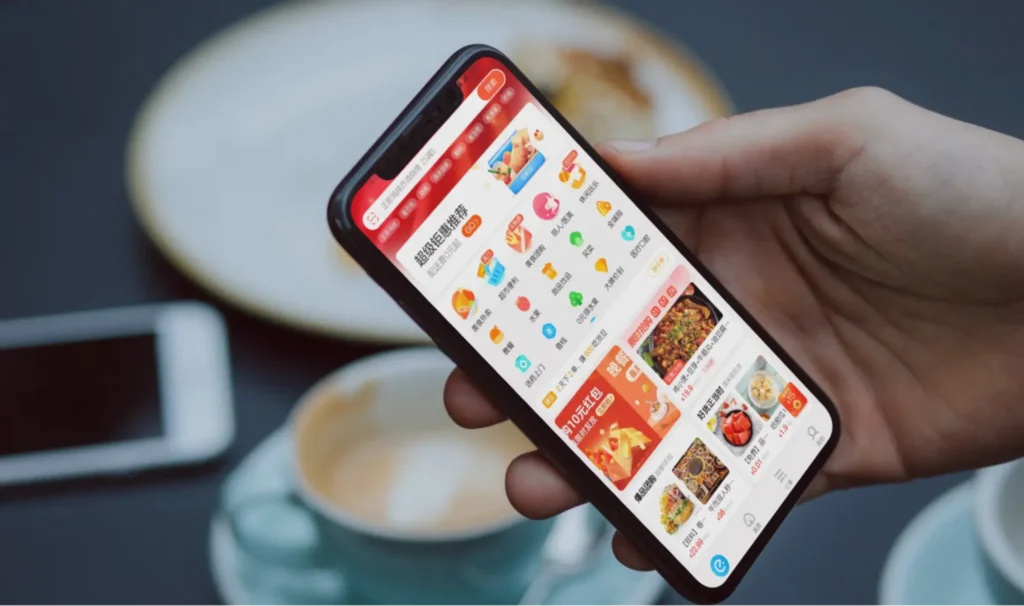
Pinduoduo’s monetization in 2025-2026 is best understood as a dual-engine marketplace model that captures value from merchant competition and transaction volume rather than from consumer pricing. Its parent, PDD Holdings, reported total Q3 2025 revenues of RMB 108.3 billion (US$15.2 billion), up 9 % year-over-year, driven almost equally by transaction services and online marketing services.
The platform deliberately protects consumer price perception and generates income by enabling sellers to compete for attention and facilitating high-velocity trade at scale.
1. Online Marketing Services: Monetizing Distribution Intensity
The largest monetization channel is online marketing services.
Pinduoduo does not depend on simple search-based ads. Instead, it sells visibility inside its feed-centric discovery engine. Merchants bid for algorithmic placement where users are already highly engaged and ready to convert. As seller density rises, competition for these placements increases, directly boosting advertising revenue without increasing consumer fees.
In Q3 2025, nearly half of PDD’s revenue came from online marketing and related services, reflecting how pay-for-performance distribution fuels profitability.
This model turns merchant rivalry into a recurring revenue base:
- Attention inside discovery feeds becomes an auctionable asset
- Conversion efficiency enhances demand for promotions
- Advertising scales with category competition
The key insight is structural: Pinduoduo monetizes distribution power, not product margins.
2. Transaction Services: Volume-Linked Commissions
Transaction services — commissions and related fees — account for the other half of major platform revenue. In Q3 2025, revenue from these services (including sales commissions, payment processing, and fulfillment fees) was roughly RMB 54.9 billion.
Unlike legacy marketplaces that raise take rates to extract margin per sale, Pinduoduo keeps them relatively low. This preserves its value proposition while relying on order velocity to compound revenue:
- Group purchases multiply commission events
- High GMV drives predictable commission growth
- Incentive structures increase repeat purchasing
A small percentage on high volume yields large aggregate revenue without disrupting competitive pricing.
3. Ecosystem Services and Merchant Tools
Beyond base advertising and commissions, Pinduoduo monetizes deeper supplier engagement through value-added services:
- Performance analytics and demand insights
- Pricing and inventory optimization tools
- Enhanced traffic allocation capabilities
As merchants depend more on platform data to plan production and pricing, switching costs increase and long-term monetization strength rises.
This creates a data dependency loop that reinforces revenue without raising prices.
4. Payments and Value Capture via Internalized Systems
By internalizing payment processing and logistics coordination components (like its own digital wallet infrastructure), Pinduoduo reduces external costs and captures ancillary value.
Owning payment flows enables future monetization beyond simple transactions (e.g., financial services), while logistics partnerships help the platform secure merchant loyalty and potentially share in fulfillment economics without heavy asset ownership.
These internalizations also contribute to stronger operating leverage across the entire marketplace ecosystem.
5. Merchandise Integration (Supplementary Revenue)
While not a core profit center in 2025, Pinduoduo also participates in select merchandise operations — particularly agriculture and fresh produce — through initiatives that strengthen direct demand signals from suppliers. Connecting millions of small producers directly to consumers supports ecosystem health and indirect monetization by reinforcing the primary marketplace model.
This aligns with the company’s mission to digitize supply chains and deliver value at scale.
6. The 2026 Monetization Equation
In simple terms:
- Consumers receive consistent value through ultra-competitive pricing and engagement design.
- Merchants compete for placement and pay for visibility and support tools.
- Manufacturers optimize production based on real-time demand signals.
- The platform monetizes distribution intensity and transaction volume, not consumer markups.
By taxing competition and coordination — not consumption — Pinduoduo captures ongoing revenue while preserving its core value offer.
That is how Pinduoduo makes money in 2026.
The Flywheel Leaders Should Study
The Pinduoduo flywheel is behavioral before it is financial.
Incentive → Participation → Demand clustering → Supplier certainty → Price compression → Higher conversion → Merchant competition → Increased monetization → Reinforced incentives.
Pinduoduo’s flywheel starts with incentives and ends with monetization, but the middle is the real engine: demand density. Once demand becomes dense and predictable, supplier behavior changes, ad competition rises, and revenue scales through merchant services. PDD’s 2025 filings keep the revenue structure simple, with revenue primarily from transaction services, online marketing services, and related merchant services.
1. Incentive Triggers Participation at the Moment of Indecision
Pinduoduo does not wait for a search query. It creates a reason to act now. Group pricing thresholds, invite mechanics, and reward loops turn browsing into a coordinated action.
Leader takeaway: incentives are not “growth hacks” here. They are a conversion infrastructure.
2. Participation Produces Order Density, not Just Traffic
When many users converge on the same SKU in a short window, the platform gets two assets at once.
First, it gets a cleaner demand signal. Second, it gets a higher conversion density per impression. That density lowers the cost of distributing the next product because the feed learns faster and merchants get clearer ROI.
Leader takeaway: Pinduoduo optimizes for repeatable density events, not one-off spikes.
3. Dense Demand Improves Merchandising and Supplier Economics
Order density gives suppliers a predictable volume. Predictable volume enables tighter production planning and reduced buffer inventory. That is how the platform can sustain aggressive value positioning without owning inventory.
Leader takeaway: the platform’s “low price” outcome is partly due to supply chain planning.
4. Better Economics Intensify Merchant Competition for Distribution
As categories become liquid, merchants compete harder for placement. That competition is monetizable. In 2025, PDD reported large and growing revenue lines in both online marketing services and transaction services, reflecting the dual engine of paid distribution plus throughput.
Leader takeaway: Once liquidity is secured, monetization scales naturally because sellers fund visibility battles.
5. Monetization Funds Reinvestment into Trust, Matching, and Allocation
More revenue allows higher investment in traffic allocation systems, quality controls, dispute handling, fraud detection, and supplier tooling. Those investments protect conversion and prevent the value promise from collapsing under quality issues.
Leader takeaway: the flywheel breaks if trust governance lags behind growth.
Pinduoduo vs Douyin vs Taobao vs JD.com — What the Structural Contrast Teaches Leaders
To understand Pinduoduo’s strategic significance, it helps to contrast it with the other dominant retail platforms shaping China’s e-commerce ecosystem.
Four platforms dominate online commerce in China today — each activating demand and monetizing value through a fundamentally different architecture:
- Pinduoduo aggregates demand through social participation.
- Douyin converts content attention into transactions.
- Taobao structures search-led discovery and merchant competition.
- JD.com builds trust through inventory ownership and deep logistics.
These differences are not cosmetic features. They are architectural distinctions that determine how each platform creates, captures, and scales value.
Pinduoduo vs Douyin — Coordination Before Transaction
Pinduoduo’s economy begins not with a search query but with collective intent. Its group purchase mechanics activate social participation before the transaction itself, turning dispersed demand into predictable volume.
In contrast, Douyin begins with content and entertainment. Users encounter products embedded in short videos and livestreams. Conversion follows attention, not pre-aggregated purchasing intent.
In simple terms:
- Pinduoduo’s sequence: Participation → Demand density → Predictable volume → Monetization.
- Douyin’s sequence: Content attention → Influence → Impulse conversion → Monetization.
This difference matters for leaders. If your strength is community density and coordinated action, Pinduoduo’s logic scales. If your strength is audience engagement and influence, Douyin’s logic dominates.
Pinduoduo vs Taobao — Feed-First Discovery vs Search-Led Marketplace
Taobao embodies the classic marketplace model: search defines intent, and users compare products within a rich SKU ecosystem. Merchants compete for visibility and rankings inside search results.
Pinduoduo, by contrast, privileges feed discovery and social incentives over typed queries. Users are guided toward offers that unlock value through collective action rather than guided by search input.
This structural difference manifests in how users behave:
- On Taobao, consumers look for what they intend to buy.
- On Pinduoduo, consumers discover value through participation and feed exposure.
Taobao monetizes search liquidity and variety. Pinduoduo monetizes participation-driven conversion.
Pinduoduo vs JD.com — Asset-Light Coordination vs Operational Certainty
JD.com built its competitive advantage on logistics infrastructure and inventory control, owning warehouses and delivery networks that ensure reliable fulfillment across categories.
Pinduoduo, by design, remains asset-light. It does not own extensive inventory or logistics networks. Instead, it focuses on coordinating demand signals and letting suppliers and third-party logistics providers fulfill orders based on predictable volume.
That difference reflects two very different solutions to risk:
- JD.com reduces consumer risk through supply chain control and delivery certainty.
- Pinduoduo reduces supplier risk by compressing demand and making production volume predictable.
JD.com monetizes the reliability and service fees associated with fulfillment. Pinduoduo monetizes merchant competition and aggregates throughput without heavy capital investment.
The Consumer Psychology Layer
Pinduoduo’s scale is not a byproduct of cheap goods. It is the outcome of deliberate behavioral design. The platform reshaped how price-sensitive consumers interpret value, risk, and participation. That psychological engineering directly supports its demand-aggregation economics.
Participation as a Trust Substitute
Pinduoduo expanded aggressively in China’s lower-tier cities, where brand loyalty was weaker and price sensitivity was higher. Instead of solving trust through branding, it solved it through coordination.
Each product displays two prices: an individual purchase price and a lower team purchase price. The lower price activates only if enough users join within a defined window. Participation counters are visible in real time.
This design reduces perceived risk in two ways. First, visible demand signals imply validation. Second, collective purchasing reduces the feeling of individual exposure. Consumers interpret volume as safety.
In markets where brand equity is uneven, coordinated demand becomes a functional substitute for reputation.
Engineered Scarcity and Decision Compression
Time-bound team formation creates controlled urgency. Users have a limited period to assemble enough participants. The clock forces faster decision-making.
Traditional marketplaces encourage comparison and delay. Pinduoduo compresses evaluation time. When the perceived value gap between individual and team price is clear, hesitation decreases.
Shorter decision cycles increase conversion velocity. Higher velocity increases order clustering. Order clustering improves supplier forecasting accuracy.
Psychology feeds supply efficiency.
Discovery Architecture Alters Buying Behavior
Unlike search-dominant marketplaces, Pinduoduo places discovery at the center of the interface. The search bar is visually secondary. Algorithmic feeds surface products based on behavioral probability rather than explicit query demand.
This changes cognitive load. Instead of typing and filtering, users scroll through high-likelihood offers. Comparison fatigue declines. The platform guides the user toward high-conversion SKUs.
From a monetization standpoint, feed-driven discovery is valuable because:
- It increases exposure to sponsored placements
- It strengthens algorithmic learning loops
- It converts browsing time into monetizable inventory
Behavioral simplicity improves commercial density.
Gamified Engagement as Frequency Control
Mechanics such as Duo Duo Orchard increased daily interaction rates by tying small rewards to app usage. These systems use progress accumulation and micro-incentives to build return behavior.
The effect is measurable in the formation of habits. When users open the app daily to maintain progress, the platform reduces reliance on paid reacquisition. Every additional open session increases the probability of exposure to sponsored content or time-sensitive deals.
Frequency stabilizes revenue predictability.
Value Framed as Achievement
Pinduoduo does not position discounts as acts of generosity by retailers. It frames them as the result of successful coordination. The psychological message is subtle but strategic: users unlock savings through action.
When savings feel earned, repeat behavior strengthens. Consumers return to replicate the achievement. This framing supports the platform’s core identity as value-first commerce without heavy brand storytelling.
Why This Layer Is Economically Critical in 2026
In 2026, global retail faces rising acquisition costs, algorithmic volatility on social platforms, and fragmented consumer attention. Platforms that rely on paid traffic must continuously reinvest to sustain growth.
Pinduoduo’s behavioral architecture produces structural advantages:
- High repeat purchase frequency
- Stable demand clustering around specific SKUs
- Strong conversion rates within feed environments
- Increased merchant willingness to pay for visibility
The consumer psychology layer is not a surface feature. It stabilizes demand density. Demand density strengthens supplier planning. Supplier planning strengthens price competitiveness. Price competitiveness reinforces participation.
The loop begins with behavior and ends with economics.
Work With Ashley Dudarenok

If you want to understand what Pinduoduo really teaches global retailers, the conversation cannot stay theoretical. It must translate into a strategy, an experimentation cadence, and operating decisions that work within your market.
Ashley Dudarenok, founder of ChoZan, works with global brands, retailers, and leadership teams to decode China’s digital commerce systems and turn them into practical growth frameworks. Her advisory work focuses on platform economics, consumer psychology shifts, social commerce, and cross-border execution in 2026 realities.
Through executive briefings, strategy workshops, and board-level advisory sessions, Ashley helps leadership teams move from surface comparison to structural understanding. The goal is clarity, not hype.
If you are evaluating marketplace expansion, social commerce activation, or a value retail strategy, you can book a consultation with Ashley Dudarenok to discuss your specific growth challenge and operating constraints.
This is not about copying Pinduoduo. It is about understanding the system logic — and applying it intelligently.
FAQs about What is Pinduoduo
Is Pinduoduo safe for international buyers in 2026
Yes, Pinduoduo’s safety for international buyers depends on seller verification and payment protections. The platform has strengthened dispute systems and compliance oversight in 2025–2026. Buyers should review seller ratings carefully and use secure in-app payment channels for protection.
How is Pinduoduo different from Alibaba
The main difference between Pinduoduo and Alibaba in the comparison is demand formation. Pinduoduo emphasizes group buying and feed discovery, while Alibaba prioritizes search and storefront competition. This structural distinction changes pricing behavior, merchant bidding, and conversion velocity across both platforms
Does Pinduoduo own warehouses or inventory
No, Pinduoduo’s inventory model remains asset-light. The platform does not typically own inventory or operate large logistics networks. Instead, it coordinates manufacturers and third-party logistics providers, reducing capital intensity while maintaining high transaction scale.
What industries benefit most from the Pinduoduo model
Industries with repeat demand perform best under the Pinduoduo demand aggregation model. Agriculture, daily essentials, and unbranded household goods align well because clustered orders reduce supplier uncertainty and support predictable production planning.
Can small manufacturers succeed on Pinduoduo
Yes, small manufacturers on Pinduoduo can compete if they respond quickly to demand signals. The platform rewards price efficiency and performance metrics rather than brand recognition, allowing agile producers to scale through volume and consistent fulfillment.
Why does Pinduoduo focus on lower tier cities
The Pinduoduo target market strategy prioritizes price sensitive segments where brand loyalty is lower and value perception is stronger. Lower tier penetration created dense order clustering early, which strengthened supplier bargaining power and accelerated platform liquidity.
How does Pinduoduo handle counterfeit concerns
The Pinduoduo quality control system relies on merchant scoring, AI monitoring, and dispute resolution frameworks. While early criticism existed, 2025–2026 governance investments improved compliance standards and refund mechanisms to protect transaction trust.
Is Pinduoduo profitable in 2026
Yes, Pinduoduo’s profitability 2026 reflects its dual revenue engine of transaction services and online marketing services. Profitability depends on maintaining merchant competition for visibility while preserving consumer price perception and platform trust infrastructure.
How does Pinduoduo support agricultural supply chains
The Pinduoduo agriculture initiative connects farmers directly to consumers through digital demand signals. By clustering orders and forecasting production needs, the platform reduces waste and stabilizes producers’ income while keeping prices competitive.
Can the Pinduoduo business model work outside China
The Pinduoduo business model outside China can work when demand density and supplier flexibility exist. However, international markets face higher acquisition costs and regulatory complexity, which require adapting incentive design and logistics partnerships carefully.