

China’s digital payments ecosystem is one of the most advanced in the world, but for foreign visitors, it has not always felt seamless. WeChat Pay and Alipay dominate everyday transactions, from taxis and restaurants to convenience stores and shopping malls. Yet many tourists have struggled with app setup, passport verification, international card linking, and limited credit card acceptance at smaller merchants.
That friction is now becoming a strategic priority. In May 2026, Tencent announced that TenPay Global would integrate with PayPal World, allowing eligible PayPal users to scan WeChat Pay merchant QR codes in China. The rollout starts with US-based users and marks an important step toward easier mobile payment in China for visitors.
For tourism boards, retailers, hotels, and global brands, WeChat Pay for foreigners is no longer just a travel convenience topic. It is part of China’s broader push to make inbound tourism more accessible, spendable, and digitally connected.
The Payment Problem Foreign Visitors Face in China

Mobile payment in China dominates daily life. For local users, paying with a QR code is fast, familiar, and deeply embedded into everyday routines. For foreign visitors, however, paying for things in China has often been one of the most confusing parts of the trip.
The challenge is not that China lacks payment infrastructure. It is that the infrastructure was built first around domestic users. Many small merchants, restaurants, taxis, street vendors, and local service providers rely heavily on WeChat Pay or Alipay. Some no longer expect cash payments, while international credit card acceptance remains uneven outside hotels, airports, luxury malls, and larger retail environments.
For years, visitors who wanted to use mobile payment in China had to download WeChat or Alipay, create an account, link an international card, and complete identity verification. While both platforms have supported international card linking for several years, the experience has not always been simple for casual travelers. Passport details, phone numbers, card issuer rules, app language settings, and verification steps could all create friction.
This made the question of how to pay in China as a foreigner more complicated than it should be. A tourist could arrive ready to spend, yet still struggle at the point of purchase. That gap between strong demand and checkout friction is exactly why payment access has become so important to China’s inbound tourism experience.
Why Payment Access Matters For China’s Inbound Tourism
Payment access is no longer a small convenience issue for China’s travel sector. It now shapes how easily visitors move through the country, how confidently they spend, and how much value tourism businesses can capture from inbound demand.
China recorded 154.50 million inbound visits in 2025, up 17.1 percent year-on-year, while inbound visitor spending reached US$131.1 billion. Foreigners accounted for 35.17 million of those visits, and visa-free trips reached 30.08 million. These figures show that China’s inbound tourism recovery is not only about arrival numbers. It is also about making the visitor journey easier once people land.
Mobile payments are already becoming part of that recovery. China’s efforts to make digital payments more accessible for international visitors are gaining traction, with inbound tourists spending around 80 billion yuan (US$11.6 billion) through mobile payment platforms in 2025.
The scale of that spending highlights growing demand for seamless digital payment options in China, especially as more visitors expect a familiar, fast, and increasingly cashless travel experience.
This matters across the whole travel economy. A smoother payment experience can influence airport arrivals, hotel check-ins, taxi rides, restaurant spending, retail purchases, attraction bookings, and tax refund satisfaction. When visitors can pay easily, they are more likely to explore, shop, dine, and move through the city with confidence.
For China’s tourism boards, malls, hotels, restaurants, and destination marketers, access to payment has become part of competitiveness. The easier it becomes for foreign visitors to use WeChat Pay, Alipay, PayPal, cards, and cash backup options, the easier it becomes to convert inbound traffic into real spending.
What The PayPal And WeChat Pay Integration Changes
The TenPay Global and PayPal World partnership transforms the payment journey by enabling eligible PayPal users to pay via China’s existing WeChat Pay merchant network. Instead of downloading a new app, creating a local payment account, or linking a Chinese bank account, users can open PayPal and scan a WeChat Pay merchant QR code.
Tencent announced the integration in May 2026 at the 20th Shenzhen International Financial Expo. The service starts with US-based PayPal users, with additional markets expected to follow in phases. For travelers who already use PayPal, this provides a more familiar entry point to China’s QR payment system.
The practical benefit is simple. A US tourist arriving in Beijing, Shanghai, Shenzhen, or another Chinese city can use PayPal at participating Weixin Pay QR code merchants. The payment is processed through WeChat Pay’s merchant acceptance network, while the charge appears on the user’s PayPal balance or linked payment method.
This matters because it removes several steps that previously discouraged casual visitors. Many travelers do not want to complete app onboarding, identity verification, card linking, and payment testing just to buy a meal, take a taxi, or shop in a local store. PayPal access reduces the learning curve and makes WeChat Pay feel closer to the payment habits foreigners already know.
For merchants, the shift is also important. They do not need to build separate payment systems for every visitor market. By accepting payments through Weixin Pay QR codes, they can serve eligible overseas wallet users through familiar Chinese payment rails. That makes the checkout experience smoother for both sides.
China’s Cross-Border Payment Interoperability Strategy

The PayPal integration is part of a wider push to connect overseas wallets with China’s QR payment infrastructure. Instead of asking every visitor to fully adapt to domestic payment habits, Chinese platforms are making local merchant networks accessible through wallets that travelers already use.
Tencent describes this approach as the “外包内用” model, in which overseas wallets can be used in mainland China via local payment rails. It first tested this model with WeChat Pay HK in 2018. The PayPal World integration now extends the same idea to a broader global user base.
The Cross-Border Interconnection Payment Gateway, or CPG, is the technical foundation behind this shift. It began trial operations in July 2025 under the guidance of the People’s Bank of China. The gateway is led by the Payment and Clearing Association of China, with participation from China UnionPay. Its role is to reduce fragmented one-to-one payment negotiations and support more connected cross-border wallet acceptance.
WeChat Pay’s network now connects with more than 40 digital payment providers and national payment networks across more than 10 countries, including PayPal, GrabPay, ShopeePay, Malaysia’s PayNet, Vietnam’s ZaloPay, and Singapore’s LiquidPay.
Alipay is moving in the same direction through international card binding and Alipay+ wallet connections. Together, these changes show that China’s digital payment market is becoming a testing ground for cross-border wallet interoperability, convenience for inbound tourism, and platform-led payment infrastructure.
How Foreigners Can Pay In China In 2026

The best way to pay in China as a foreigner is to prepare more than one option. China’s payment system is highly digital, but the visitor experience can still vary by city, merchant type, phone number, card issuer, and app setup.
WeChat Pay With An International Card
Many visitors can use WeChat Pay by linking an international bank card to their WeChat account. Tencent said in 2026 that first-time users who link an international card to WeChat would receive a 90-day waiver on the 3 percent international card processing fee for daily spending up to RMB 1,000.
Tencent also said foreign-traveler transactions through Weixin Pay linked to international cards rose nearly 80 percent year-on-year from January to April 2026. This shows that WeChat Pay is becoming easier to use for foreigners, especially for daily purchases.
Travelers should complete setup before busy travel days, keep passport details consistent across apps, and test a small payment early in the trip.
PayPal Through Weixin Pay QR Codes
Eligible PayPal users can also pay at Weixin Pay QR code merchants through the TenPay Global and PayPal World integration. The rollout starts with US-based PayPal users, with more markets expected to follow in phases.
This option is useful for travelers who already use PayPal and want a familiar payment route without relying only on local app setup.
Alipay With An International Card
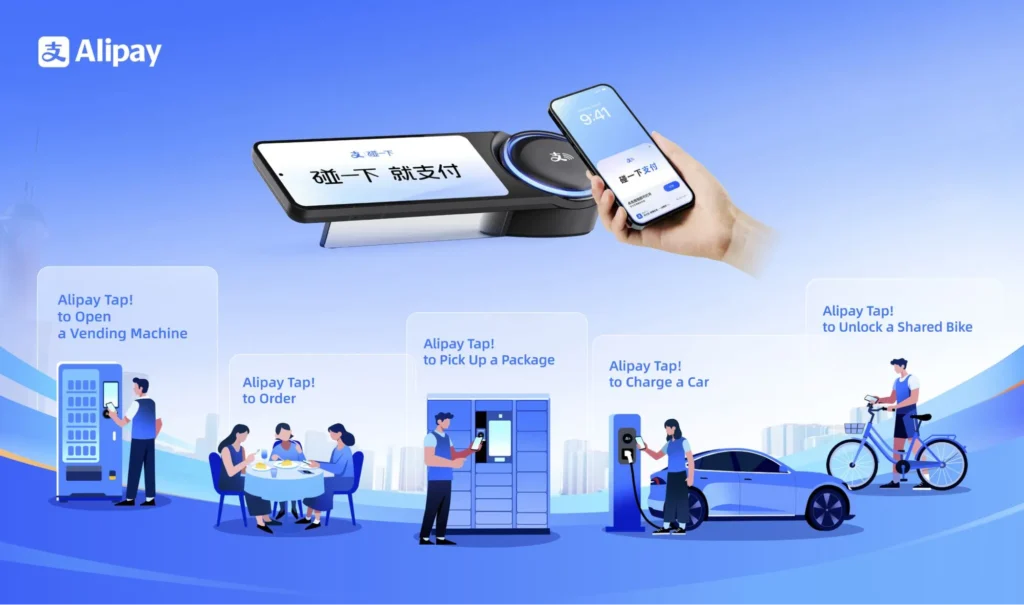
Alipay remains another important payment method for foreigners in China. Overseas users can download Alipay, choose the international version, and bind an international bank card. Alipay can be used for shopping, taxis, public transport, flights, hotels, restaurants, and other travel needs.
In February 2025, American Express and Alipay also said global American Express card members could link their cards to Alipay and pay at tens of millions of merchants across mainland China.
Cards And RMB Cash As Backup
International cards are still useful at hotels, airports, larger malls, luxury stores, and some restaurants. They should not be the only payment method, especially outside major commercial environments.
Travelers should also carry some RMB cash for backup. Cash can help in smaller locations, during phone issues, when an app verification fails, or when a merchant cannot accept a foreign-linked wallet.
For most visitors, the best payment method in China is not one single tool. A practical setup includes WeChat Pay, Alipay, PayPal access where available, an international card, and some RMB cash.
WeChat Pay vs Alipay For Foreigners
The question of Alipay vs WeChat Pay for foreigners remains relevant. Alipay has historically been considered more foreigner-friendly, with a dedicated international version and simpler onboarding. Alipay now supports seven international bank cards and 31 mobile wallets from 12 countries and regions.
For foreigners, WeChat Pay vs. Alipay is no longer a binary choice. Both platforms are converging toward interoperability. The CPG gateway enables both to accept a growing roster of international wallets.
WeChat Pay’s network now connects to over 40 digital payment providers and national payment networks across more than 10 countries, including PayPal, GrabPay, ShopeePay, Malaysia’s PayNet, Vietnam’s ZaloPay, and Singapore’s LiquidPay.
Does WeChat Pay work for foreigners? The answer is increasingly yes, with expanding options. The PayPal integration answers this question definitively for a large segment of international travelers.
What This Means For Tourism, Retail, and Hospitality Brands
Payment access now shapes how foreign visitors experience China. It affects airport arrivals, hotel check-ins, taxi use, restaurant spending, retail conversion, attraction bookings, tax refunds, and repeat visits.
For tourism boards, malls, hotels, restaurants, retailers, and destination marketers, easier digital payments help convert inbound traffic into real spending. Visitors who can pay quickly are more likely to shop, dine, travel across the city, and explore beyond major tourist zones.
Shenzhen shows this shift clearly. Ahead of APEC 2026, Tencent said its inbound payment upgrade includes access to PayPal World, a fee waiver for international card users, and payment guidance in 16 languages at ports of entry, airports, business districts, and banks. Shenzhen also reported 189 million payment-service transactions worth RMB 26.4 billion for international visitors in 2025.
For brands, the priority is simple: support WeChat Pay, Alipay, international cards, and provide clear cash-back guidance. Train staff and add multilingual checkout instructions where foreign visitors are likely to pay.
Explore China’s Digital Transformation With Ashley Dudarenok

China’s payment ecosystem is changing how visitors move, spend, and interact with brands. Ashley Dudarenok helps global leaders understand these shifts through China-focused keynotes, executive briefings, advisory sessions, and research.
From digital payments and tourism recovery to retail innovation and platform strategy, Ashley turns complex market changes into clear business insight. Book a consultation to explore how China’s payment and consumer trends affect your organization.
FAQs
What is the easiest way for tourists to pay in China now?
The easiest route is usually a mix of WeChat Pay For Foreigners, Alipay, an international card, and some RMB cash. The setup should happen before arrival, then travelers can test QR payments on small purchases.
Can PayPal users pay directly in China with WeChat Pay?
Eligible PayPal users can pay through Weixin Pay QR code merchants under the Tencent TenPay Global and PayPal World integration. The service starts with U.S. users, with more markets expected in later phases.
Do tourists still need cash in China?
Tourists should still carry some RMB cash, especially for smaller locations, as a backup, or in case of phone issues. China is highly mobile-first, but a practical visitor payment plan should not depend on a single app.
Which app should I set up before visiting China?
Set up both WeChat and Alipay when possible. WeChat supports social and local services, while Alipay offers robust travel payment features. Having both reduces friction across different merchants and scenarios.
Why do foreign cards sometimes fail in China?
Foreign cards may fail because some smaller merchants prioritize QR code wallets over card terminals. Acceptance also depends on location, merchant type, card network, bank controls, and the payment route used at checkout.
Are QR code payments safe for foreign visitors in China?
QR code payments are widely used in China, but visitors should scan only official merchant codes and check the amount before confirming. Use trusted apps, keep phone security active, and avoid unknown payment links.
How does PayPal World help China travel payments?
PayPal World connects major wallets and payment systems across borders. For China travel, it helps eligible PayPal users access Weixin Pay merchant QR codes without learning every part of China’s local payment ecosystem.
Is WeChat Pay better than cards for small purchases in China?
WeChat Pay is often more convenient for small purchases because many daily merchants are built around QR payments. Cards remain useful for hotels, airports, malls, and larger purchases where POS acceptance is stronger.
Can foreign tourists use WeChat Pay for taxis and restaurants?
Foreign tourists can often use WeChat Pay for taxis, restaurants, retail, and local services after account setup and card linkage. PayPal QR access may also expand convenience at Weixin Pay merchants for eligible users.
What should brands do to support foreign tourists in China?
Brands should support WeChat Pay, Alipay, cards, and clear multilingual payment guidance. Staff training matters too. A smooth checkout experience can increase visitor confidence, reduce abandoned purchases, and improve destination perception.